Farm-funded hedges: what the numbers really say
Real footprint, Walloon support, fodder, wood: what science establishes about the profitability of farm hedges — and what it doesn't.
Since Yes We Plant was launched, more than 4,200 km of hedges and close to 1,460,000 trees have been planted in Wallonia (Yes We Plant portal counter, read on 8 September 2026) — the 4,000 km target, announced as met in January 2024, has been exceeded. That’s considerable. And yet, when we meet farmers on their plots, the conversation almost always snags on the same two sentences: “I’m going to lose land” and “I’m not getting into thirty years of paperwork.”
These are good objections. They deserve more than a speech. They deserve numbers — including the awkward ones.
So we went through the file with a fine-tooth comb. What follows is what the scientific literature actually establishes, with sources and dates. You’ll see that on one important point, it establishes far less than what you read everywhere. We’d rather tell you.
“I’m going to lose land”: what it really costs
Let’s start with objection number one, because it can be quantified precisely.
A hedge of 60 metres per hectare takes up 1.2% of the area. At 100 metres per hectare in grassland, you reach 2%. In in-field agroforestry, with 30 to 50 trees per hectare, the footprint reaches 5% (INRA report, Metay, Butault & Bamière, 2013). In a planting of 50 trees per hectare, 92% of the plot stays cultivated, and the intercrops remain very productive for the first twenty-five years (Dupraz & Capillon, INRA Montpellier, 2005, European SAFE programme).
In other words: the land lost is real, but it’s counted in single-digit percentages, not in tens.
Then comes the windbreak effect. A hedge creates a zone of reduced yield at its foot, over half to one and a half times its height, then a zone of improved yield that carries much further: gains are generally observed up to ten times the hedge’s height (Vézina 2001, citing Lyles et al. 1984 and Baldwin 1988), and the windbreak effect remains measurable up to twenty times that height (French Office for Biodiversity, 2023, citing Burel 2021, Vézina 2001, Baudry et al. 2000). A 5-metre hedge therefore influences the plot over 100 metres. The gain zone is at least ten times wider than the loss zone.
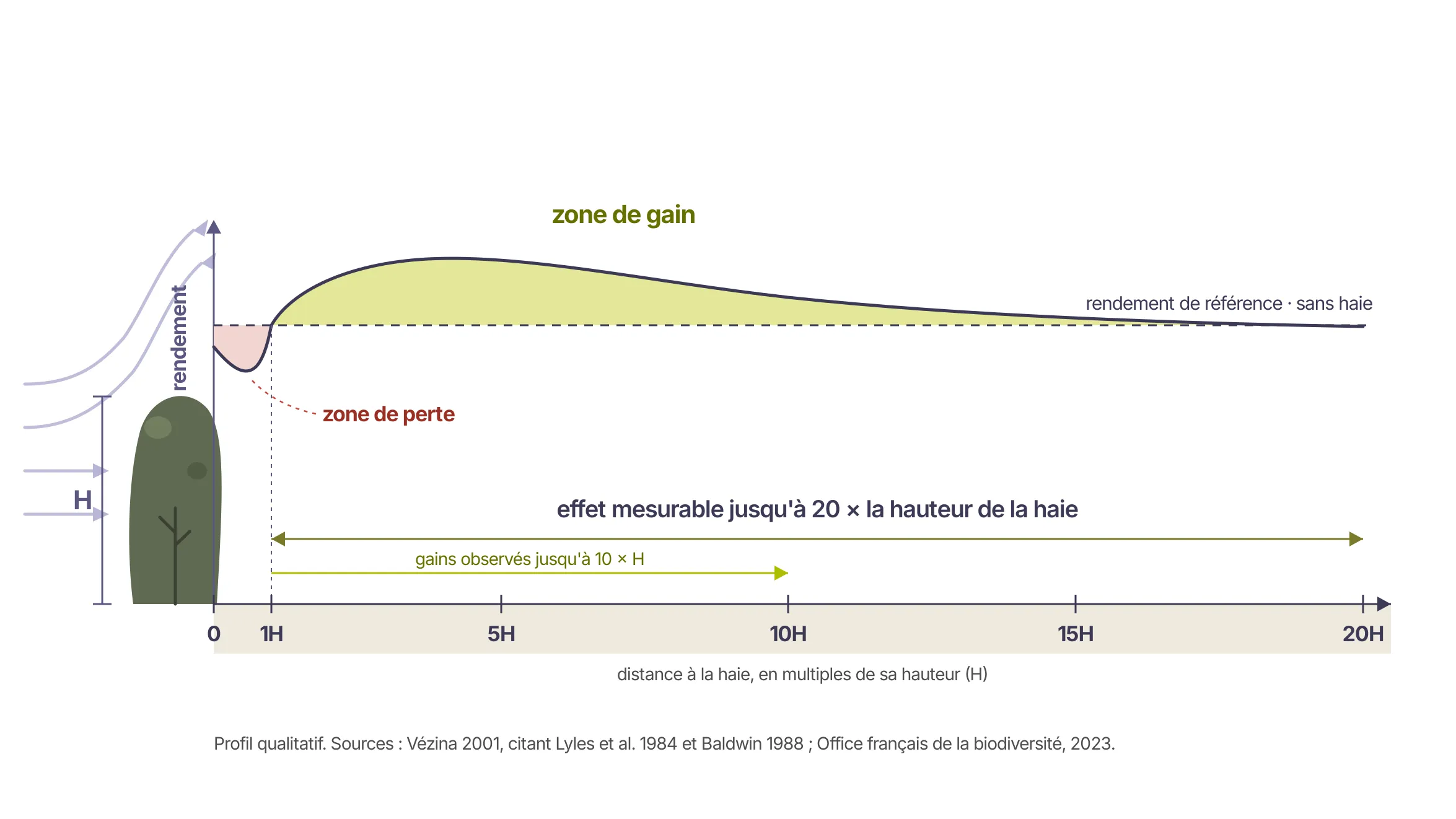
The same OFB work documents soil water reserves higher by 5 to 10% in the surface horizons (citing Delahaye 2021), and a reduction in spray drift of 10 to 90% over about three times the height of the trees (citing Bedos et al. 2020, Wenneker & Van de Zande 2008) — which is also a matter of regulatory compliance, not just agronomy.
And now, the thing we have to tell you.
What science doesn’t say
You’ve no doubt read that a hedge boosts yields by 5 to 30%. That figure circulates everywhere. We won’t use it.
The reference European meta-analysis — Ivezić, Yu & van der Werf, published in 2021 in Frontiers in Sustainable Food Systems, thirteen publications, twenty-two sites, 267 observations — says so explicitly: there are no consolidated quantitative European data on hedges and windbreaks. The percentages in circulation mostly come from North American trials or from popularised summaries, copied from one to the next, rarely from a European primary source.
What this meta-analysis does establish concerns in-field agroforestry, and it’s no slogan: relative yield is 96% in the planting year, then falls by about 2.6% per year over twenty-one years, and yield drops by 20% for every additional 100 trees per hectare. The directly useful translation: low densities are much preferable, and a field-edge hedge is not the same economic case as a full-field planting.
We could have sold you a flattering percentage. An unverifiable figure doesn’t last three minutes in front of someone who knows their plots.
The calculation no one does
Here, to our mind, is the strongest argument in the file. It requires no study — only two official figures and a division.
Routine maintenance of a hedge costs between €0.10 and €0.30 per metre per year (French chambers of agriculture, i.e. €10 to €30 a year per 100 metres; the sustainable-management benchmark of Afac-Agroforesteries, now Réseau Haies France, June 2024, based on close to 80 references across 11 regions, gives €3.69/linear metre on average per management operation, €5.19/lm with a contractor).
The Walloon “ecological network” eco-scheme converts every metre of hedge into 0.001 environmental hectare. A thousand metres of hedge therefore make one environmental hectare. At €450/ha planned for 2026, that amounts to about €450 per year for a kilometre of hedge — roughly €0.45 per metre per year, multiplied by 1.5 in Natura 2000 areas.
The support covers routine maintenance, and leaves a positive balance. Everything else — the wood, the fodder, the fruit — comes on top.
Two honesty caveats. First, the €450 figure is planned: the regulatory range runs from €350 to €600/ha, and the 2023 and 2024 campaigns actually paid €410/ha. Second, it’s a political scheme, revisable at each programming period. It has to be taken as such.
To this is added the planting subsidy: €5/m for a single-row live hedge, €7/m for two rows, €9/m for three rows or more, with a 50% uplift when the planting is done by a specialist firm — up to €13.50/m, capped at 80% of the invoices (SPW, scale checked on 8 September 2026). In return: a commitment to maintain for 30 years, 80% minimum establishment, and an application to file within six months of the works, with an optional prior opinion before planting.
Diversify: what a hedge produces on top
This is where the file gets interesting, and we deliberately rank by how solid the data is.
Woody fodder is the newest and most robust data. A study by FiBL and Agroscope published in April 2025 in Recherche Agronomique Suisse (Galland, Dind, Schmid, Mesbahi, Dubois, Probo & Mariotte) establishes that six to seven branches of ash or white willow, 5 cm in diameter, make up 20% of the daily ration in dry matter of a dairy cow. Better: the leaves contain 130 to 180 g of protein per kg of dry matter — white willow at 180, hazel at 162 — against 142 g/kg for a grass-dominated reference grassland fodder. They’re also lower in fibre than summer grass. A thirty-year-old ash managed as a pollard produces about 30 kg of ingestible dry matter, enough to feed five to seven heifers for a day (Monier & Hekimian, Fourrages 242, 2020).
The problem this answers is familiar to every livestock farmer: in an extreme climate year, grassland yield can fall by up to 40% in French-speaking Switzerland (Calanca et al., 2022). A fodder hedge is a standing stock that doesn’t scorch in July. A useful caveat: the study is Swiss, run on six farms in French-speaking Switzerland — the same species, a similar climate, but it isn’t Walloon data.
Wood energy, for its part, is modest, and we say so plainly. The gross margin sits around €150 per kilometre per year from sales alone (Réseau Haies, cited by Perspectives Agricoles, February 2026). A worked case from Réseau Haies France — an 85-hectare farm with 3.5 km of Label Haie–certified hedges, about 16 dry tonnes a year — could generate up to €4,120/year combining sales and on-farm use. It’s a real supplement, especially for on-farm use. It’s not a main income, and anyone who presents it that way is telling you a story.
Coppice deserves a counterpoint. Linear coppice — integrated into the hedge — is well subsidised in Wallonia: €1.50/m for one row, €3/m for two, €4/m for three or more, before the 50% uplift when a firm does the planting. On the other hand, the review of very-short-rotation coppice in Wallonia published by Forêt.Nature (Laurent Somer, 2013) is cautious: the profitability of full-field SRC is very hard to establish here. The price of its chips cannot compete with forest chips, the plot is tied up for twenty years, and the only Walloon coppice support targets linear coppice. In 2012, Wallonia had 68 hectares of SRC. Our recommendation: coppice in the hedge, yes; a dedicated planting, no.
Small fruits — elder, sloe, hazelnut, rosehip — genuinely enrich a hedge and open up processing outlets. We won’t give you a figure: there’s no reliable, published Belgian producer price for these species. We prefer an acknowledged blank to an estimate dressed up as data.
Flow versus stock: the real shift
If you only remember one idea, let it be this one.
A hedge doesn’t replace an annual income. It turns a small part of that flow into stock: standing capital, backup fodder, held soil, retained water, a sheltered herd. It’s a change of timescale, not a sleight of hand.
The most complete simulation we have shows it well. On a 100-hectare arable farm, with an agroforestry unit set up gradually over a quarter of the area, overall income falls by 3% at twenty-five years, then by 10% at the first tree harvest — and then finds itself multiplied by 1.2 to 1.5 (Dupraz & Capillon, 2005). The dip is real. It’s quantified, it’s crossable, and what lies on the other side is higher.
Let’s add the nuance popularisation glosses over: in the only system where the Land Equivalent Ratio has been measured over a full tree cycle — poplar and durum wheat, LER of 1.3 — the crop’s relative yield is 0.50 and the trees’ is 0.83 (Talbot 2011, cited in the 2013 INRA report). The overall gain comes from the wood, not the wheat. At high density, you don’t produce more cereals: you produce something else, on top.
That’s exactly what “thinking in decades” means.
“And the paperwork?” — that’s our part of the job
This is the second brake, and it’s the one we take on most directly.
Semisto handles the plot diagnosis, the agroforestry design, the planting by a specialist team — which can open the 50% uplift provided when a firm does the work — and the full administrative assembly of the support.
What stays with you: the decision, the thirty-year commitment, and routine maintenance. We don’t pretend otherwise. But between the SPW scales, the eco-scheme coefficients, the filing deadlines and the fit with your CAP declarations, there’s file work that has no reason to cost you your evenings.
One point to watch, because it regularly causes confusion: the old “hedges and wooded strips” agri-environmental measure no longer exists in the 2023-2027 programming period: its elements are paid through the ecological-network eco-scheme. So the two don’t stack.
Shall we look at what your farm can mobilise?
We always start the same way: a plot diagnosis, on the ground, with your real constraints — your rotations, your machinery passages, your water points, your wind zones. We come out of it with what your farm can actually mobilise, in metres and in euros.
Discover the “Farm-funded hedges” offer
And if you’d rather check for yourself first — that’s a good reflex — Natagriwal supports Walloon farmers on these schemes free of charge: 0493 33 15 89. We give you their number on purpose. Everything you’ve just read is verifiable, and we’d rather you verified it.
Review of 8 September 2026: the yield-loss zone at the foot of a hedge was brought back from about twice to about once its height, in line with Vézina 2001, and the diagram corrected; the wording on very-short-rotation coppice, the wood-energy worked case and the linear-coppice uplift was made more precise.