Investigations
A lot gets repeated about food forests — by us too. Here, we check: in the studies, the official figures, the field measurements. Then we write what we find, including when it proves us wrong.
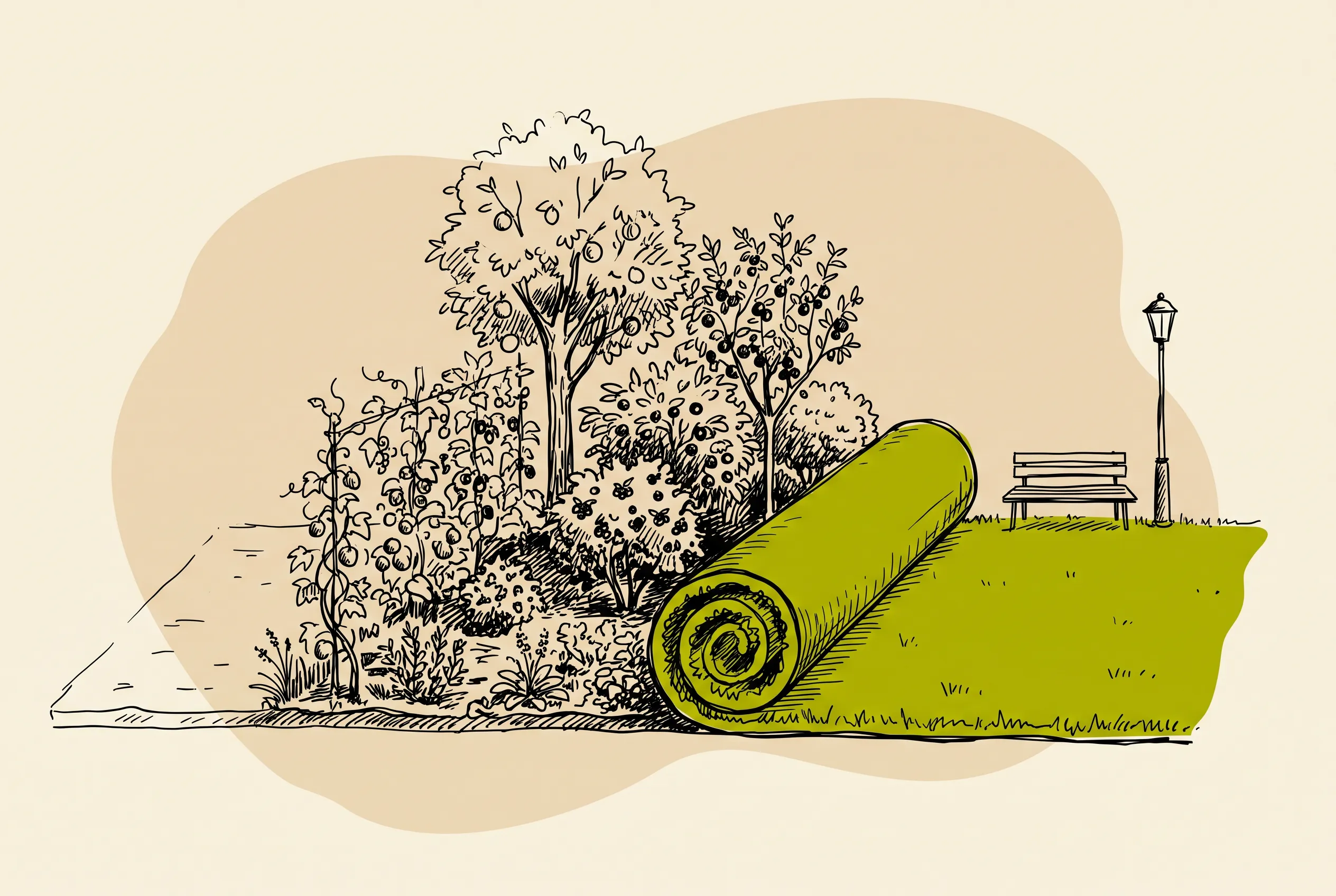
What 30 Swedish urban food forests have to say to local councils
Sweden has inventoried its 30 urban food forests. The figures upend the usual pitch and show what a council should actually be funding.
-
100 € for twenty metres of hedge: Wallonia's planting grant is worth the paperwork
Open to everyone, private individuals included, and paid as a flat rate: what the planting grant can cover, on what conditions, and how to apply.
consolidated Walloon Government decree, SPW handbook, review by the planting grant service August 27, 2026 · 11 min read -
Feeding more, or feeding better?
Does a food forest feed people better than a field? We read the studies: calories, protein, micronutrients — where the argument holds, and where it breaks.
12 studies cross-checked August 21, 2026 · 22 min read -
What does a food forest earn? The first economic study, decoded
Can a food forest support a farm? The first economic study (ILVO) decoded: the conditions for profitability, its limits, and what changes in Wallonia.
ILVO cost-benefit analysis, 2024 August 4, 2026 · 5 min read -
The drier it gets, the more trees store carbon: agroforestry's edge against scorching summers
A 2025 global meta-analysis shows it: agroforestry stores the most soil carbon where it is driest. A climate argument for a drying Wallonia.
global meta-analysis, 2025 July 24, 2026 · 4 min read -
A hundred times more woodlice than a field: the proof that food forests regenerate the soil
A Belgian-Dutch study compared 15 food forests to fields and grasslands. Their soil comes to resemble a forest's. Here are the numbers.
15 food forests measured July 24, 2026 · 5 min read -
Farm-funded hedges: what the numbers really say
Real footprint, Walloon support, fodder, wood: what science establishes about the profitability of farm hedges — and what it doesn't.
Walloon figures and agronomic literature July 23, 2026 · 10 min read
An investigation is still an article: it keeps its place in the journal, filed in its layer. What sets it apart is the checking — and the fact that we also write down what we could not establish.