A hundred times more woodlice than a field: the proof that food forests regenerate the soil
A Belgian-Dutch study compared 15 food forests to fields and grasslands. Their soil comes to resemble a forest's. Here are the numbers.
A hundred times more woodlice than a field: the proof that food forests regenerate the soil
When you plant a food forest on a former maize field, you know you’re doing something right. You feel it underfoot, at the end of summer, when the soil turns soft again and smells of humus. But “you feel it” has never convinced anyone in a town-council meeting, or a farmer counting their hectares. We needed numbers. They’re here now — and they come from right where we are.
In March 2026, the scientific journal npj Biodiversity (Nature group) published the first large study of food forests in North-West Europe. Two researchers, Isabelle van der Zanden and Lieke Moereels, with the Forest & Nature Lab at Ghent University and the Netherlands Institute of Ecology, compared 15 food forests in Belgium and the Netherlands — aged 6 to 29 years, from 0.18 to 3 hectares — with 38 reference sites: intensive croplands, permanent grasslands and forests. In each soil, they counted twelve groups of organisms, from invisible bacteria to earthworms, by way of woodlice and millipedes.
The result fits in a single sentence: a food forest’s soil no longer resembles a field’s. It resembles a forest’s.
What teems in a soil you’ve stopped ploughing
Here are the numbers, compared to a neighbouring cropland. They’re raw, and that’s what makes them powerful.
A food forest holds a hundred times more woodlice than a field (100×, exactly). Almost fourteen times more mites (13.9×). More than five times more millipedes (5.6×). More than four times more springtails (4.3×), those tiny jumpers that shred organic matter. On the invisible side, bacterial biomass rises by a third (1.4×), non-mycorrhizal fungi nearly double (1.8×), and mycorrhizal fungi — the ones that link roots together — are one and a half times more present (1.55×).
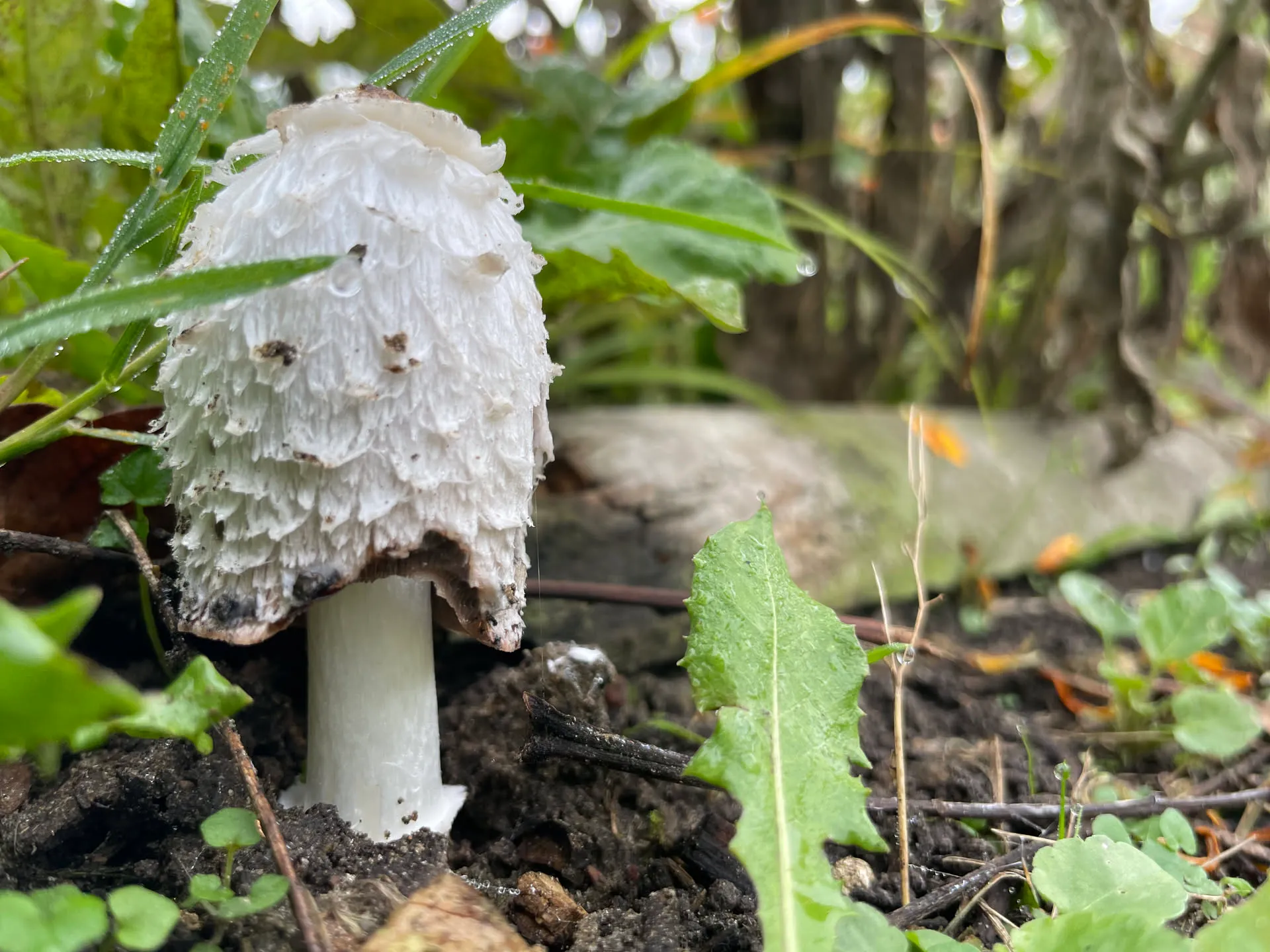
These aren’t incidental creatures. Woodlice, millipedes, springtails and fungi are the workers of the soil: they break down litter, turn it into humus, release nutrients, and build the crumbly structure that holds water. Where ploughing and inputs had made them disappear, the food forest calls them back.
A piece is only as strong as what it doesn’t hide
We could stop there. It would be dishonest, and you’d sense it. The study also shows less flattering things, and they matter.
Earthworms are no more numerous in food forests than in fields (0.80× — slightly fewer, without a meaningful difference). Ground beetles, those predatory carabids, are even markedly less present (0.18×). Compared to a permanent grassland, a food forest also loses on some counts: fewer mycorrhizae, fewer earthworms. Grassland, never ploughed and permanently covered, remains a very good soil — the food forest doesn’t outclass it everywhere.
What the food forest does that is spectacular is something else: it brings back, in force, the groups tied to litter and to forest life — woodlice, millipedes, decomposer fungi, harvestmen. The authors put it cautiously: converting intensively farmed land into a food forest can “locally improve soil biodiversity, particularly for disturbance-sensitive groups.” That’s a scientist’s phrasing. In field language: you give the soil back its forest life, on a plot that produces food.
Why this changes the conversation
Until now, planting a food forest was a matter of conviction. We believed in it, we showed photos, we talked about resilience. Now we can lay down a table of figures, peer-reviewed, measured on real sites a few kilometres from here — not in some distant tropics, not in a theoretical model. A hesitant town council, a doubtful farmer, an administration deciding what to fund: all can read the same numbers.
And those numbers say something simple. A food forest isn’t one more pretty gesture. It’s an act of measurable regeneration of underground life, on land that intensive agriculture had depleted. The soil is the first beneficiary — and a living soil means water retained, carbon stored, healthier plants and steadier harvests. Everything starts there.
Come and see for yourself
We design food forests for individuals, towns, farmers and companies, and we train those who want to learn to do it. Every project is a small plot given back to life — and, if this study is right, a little factory of woodlice, fungi and humus.
Do you have a piece of land, a meadow, a corner of a field you don’t quite know what to do with? Come, let’s look together at what could grow there. And if you want to truly understand living soil, the Semisto 2026-2027 course teaches you to read a plot and design the forest that will regenerate it.
Source: Isabelle van der Zanden, Lieke Moereels et al., “Planting food forests can increase soil biodiversity in agricultural landscapes of Northwest Europe,” npj Biodiversity, 30 March 2026. Open access: nature.com.