The drier it gets, the more trees store carbon: agroforestry's edge against scorching summers
A 2025 global meta-analysis shows it: agroforestry stores the most soil carbon where it is driest. A climate argument for a drying Wallonia.
The drier it gets, the more trees store carbon: agroforestry’s edge against scorching summers
This summer again, Wallonia was hot and thirsty. Meadows turned yellow in July, gardens begged for the watering can, and the question returns with every heatwave: how do you farm when water runs short and the sun beats down? We look for technical answers — resistant varieties, irrigation, shade structures. There’s one that’s older and quieter, and answers both problems at once: planting trees among the crops and the pastures.
And science has just handed it an argument no one saw coming.
The paradox of dry regions
In 2025, a team of researchers pooled 561 field comparisons from around the world to measure, in a meta-analysis published in the journal Catena, what agroforestry does to soil carbon. The overall result: combining trees with crops increases the soil’s organic carbon stock by 10.7% on average compared to the same land without trees.
But the figure that matters for us lies elsewhere. That gain isn’t uniform: it is strongest in arid and semi-arid zones, at +18.7%. Where the soil is most stressed, poorest in organic matter, most threatened by drought — that is where trees make the biggest difference.
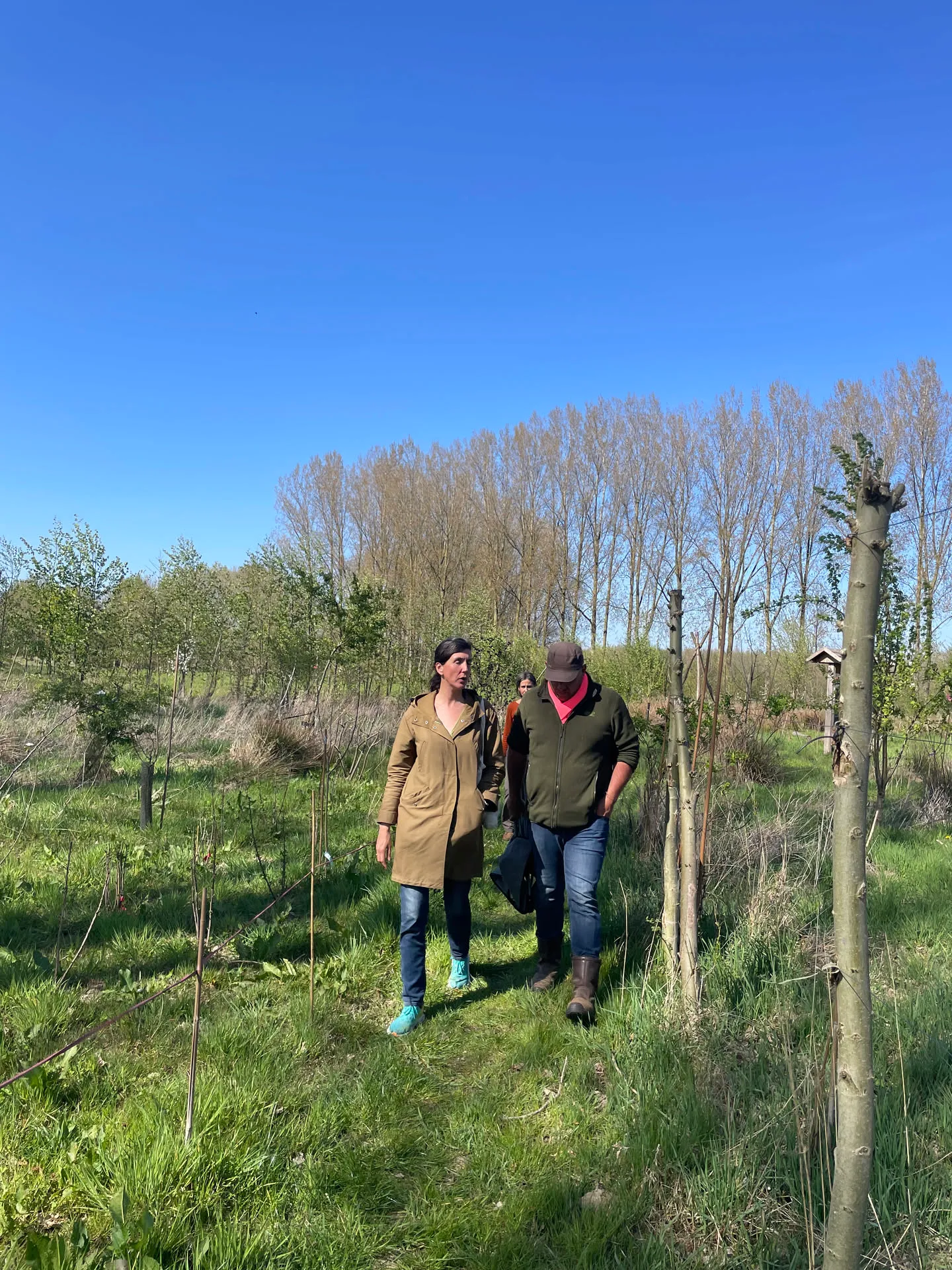
This isn’t a statistician’s curiosity. It’s a direct signal for a region like ours, whose summers increasingly resemble those of central France. As Wallonia dries out, the value of the tree in the field doesn’t fall: it rises. Stored carbon isn’t only a service to the climate — it’s organic matter, so a water sponge and a living soil, so a soil that better withstands drought. The tree answers the thirst at the same time as it answers the carbon.
The tree: an air conditioner that also produces food
Carbon is only half the story. The other half you feel in your body the moment you step from a bare field into an understorey: it’s cooler there.
A scientific review published in 2025 in Climate Resilience and Sustainability compiled what tree shade changes for the crops growing beneath. Under the canopy, temperature can drop by 2 to 4 °C at the hottest hours. Extremes are buffered: fewer heat spikes on the leaves, less evaporation, less stress. Under climate stress, these works even report yield gains of around 5 to 15%. These measurements come mostly from systems in the Global South — they should be read as a principle, not as a Walloon figure — but the mechanism itself is universal: a well-placed tree protects what grows at its feet.
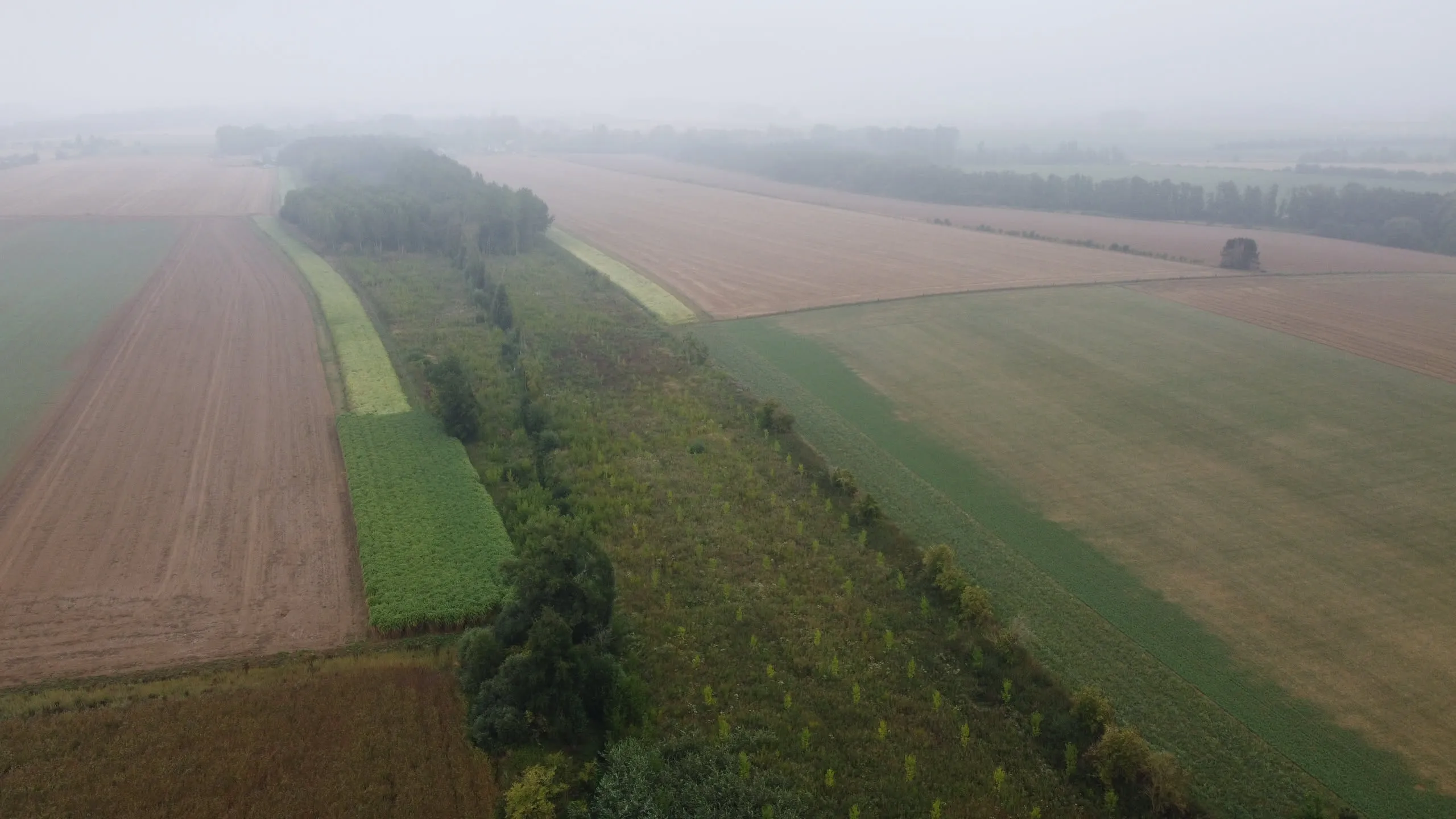
This is exactly what a food forest does, denser and more diverse than a simple row of trees. Its stacked layers create a microclimate: the canopy breaks the wind and the sun, the soil stays covered, moisture is kept. What intensive agriculture removed — hedges, scattered trees, edges — the food forest reintroduces in abundance.
What a slogan won’t tell you
Let’s be precise, because this is what separates a solid argument from wishful thinking. The Catena meta-analysis measures soil carbon: it doesn’t say every hedge will save the climate, nor that a tree planted today sequesters tomorrow. Storage builds over years, it depends on soil, climate and species, and it doesn’t remove the need to cut our emissions. Likewise, the 2 to 4 °C of shade come from crops in the Global South: here, the effect exists but remains to be finely quantified.
What these works do establish is robust and convergent: combining trees with crops rebuilds soil carbon, and does so all the better as the climate is dry. For the Wallonia of 2026 and the decades to come, that’s less a piece of good news than a compass.
Think in decades, plant this autumn
The tree you put in the ground this winter won’t cool next summer’s heatwave. It will cool those of 2040, when they’ll be harsher. That’s the nature of a tree: it works for a climate that isn’t here yet. Waiting until you’re hot to plant is planting twenty years too late.
Are you a farmer watching your plots scorch every summer? Do you manage a public space suffering from the heat? Let’s talk about what well-placed trees could change there. And to learn to design systems that produce, cool and store all at once, the Semisto 2026-2027 course is open.
Sources: Pan et al., “Agroforestry increases soil carbon sequestration, especially in arid areas: a global meta-analysis,” Catena, vol. 249, 2025 (561 paired observations). Abebaw et al., systematic review on agroforestry and microclimate, Climate Resilience and Sustainability, 2025.