What does a food forest earn? The first economic study, decoded
Can a food forest support a farm? The first economic study (ILVO) decoded: the conditions for profitability, its limits, and what changes in Wallonia.
It is the question that comes up at every course, every visit, every conversation with a farmer looking at their pasture differently: “Fine, it’s beautiful, it’s alive — but can it make a living?”
For years, we answered with convictions, pioneer examples and orders of magnitude. Since 2024, we can answer with a study. The Flemish institute for agricultural research ILVO published the first complete economic analysis of a food forest at farm level. It went almost unnoticed on the French-speaking side. We decode it for you — what it shows, what it does not show, and what changes in Wallonia.
What ILVO did
Rather than waiting twenty years for a pilot farm to publish its accounts, the ILVO team built a fictitious but realistic case: the conversion of 0.8 hectare of pasture into a food forest, about 1,000 trees and shrubs, calibrated on the experimental site of Eetbos Deinze and validated with three Flemish farms already growing food forests. It is the same method we used to imagine the typical corporate food forest: when the future does not exist yet, you cost it on a case made entirely of elements that do.
Helena Tavernier, researcher at ILVO, sums up the intention: it is the first time the costs and benefits of a food forest have been laid out, with the legislation and the state of knowledge gathered in one place.
What the study shows
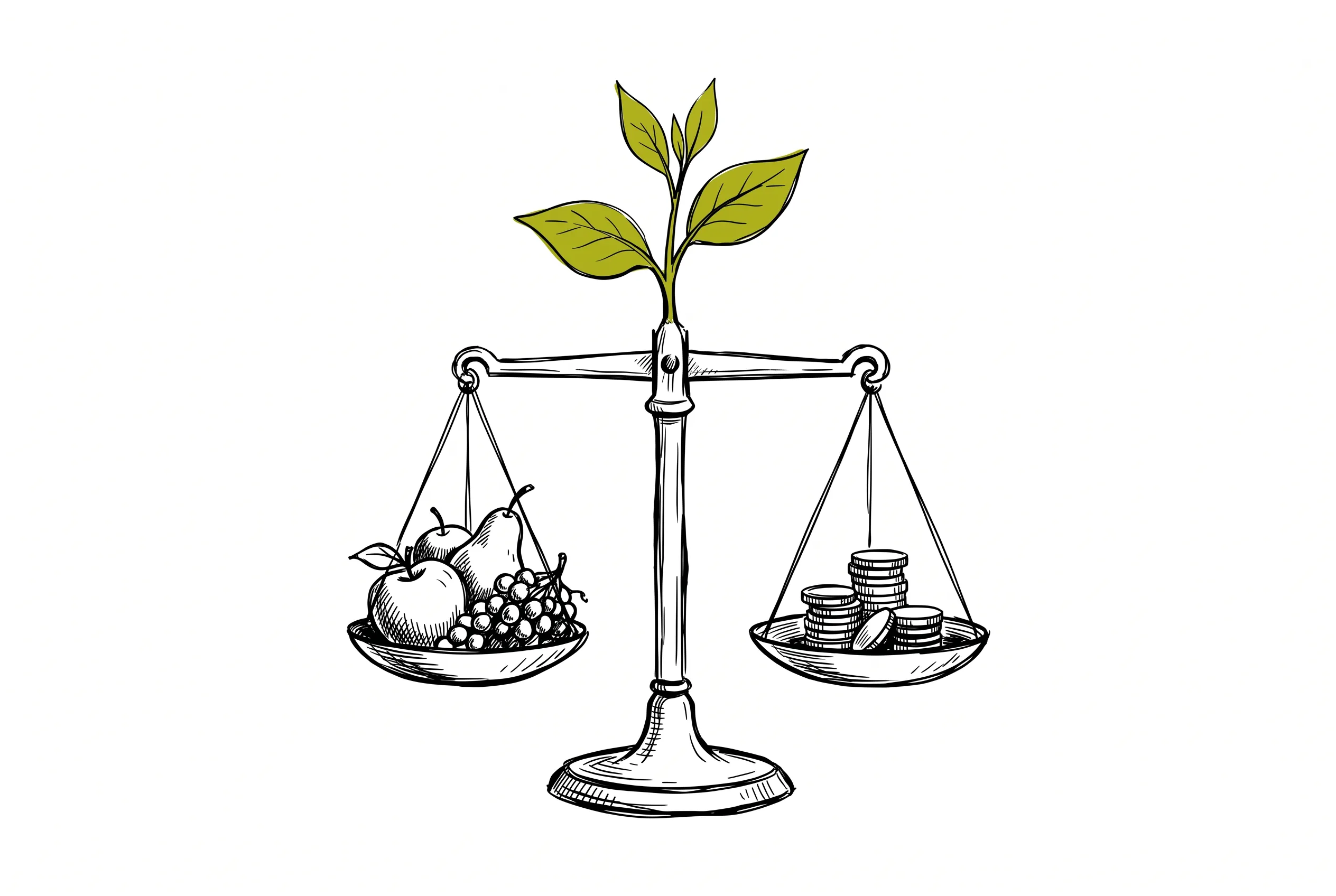
The conclusion fits in one sentence: yes, a food forest can be profitable for a farm — under conditions. And the conditions are precise:
- Diversify the income streams. The model that works combines self-picking, workshops and educational tours, and the sale of fresh and processed products. Each channel brings customers to the others.
- Process to sell all year round. The farm store is a heavy investment — but it is what lets you sell jam in February rather than redcurrants in July only.
- Outsource wisely. Planting by a contractor, sales by a student, harvesting… by the customers: self-picking turns your heaviest cost item into a paid experience.
- Activate the subsidies. In the case studied, the Flemish planting and maintenance subsidies cover nearly 30% of the total investment.
What the study does not show
This is where most articles stop, and this is where it gets interesting. The ILVO team is the first to point out its own uncertainties: the yields of the trees and shrubs and the real labour time are the most fragile data in the model, simply because mature, measured food forests are rare — Sarah Carton, researcher at ILVO, says so plainly.
And the context tempers easy enthusiasm: of 21 Flemish food forests surveyed by a UGent master’s thesis, half were planted between 2015 and 2020, more than half cover less than half a hectare — and only two provided a full income at the time of the study. That is not an admission of failure: it is the portrait of a sector that is ten years old. Organic orchards and craft breweries went through the same curve.
And in Wallonia?
Three things change when you cross the language border.
The subsidies first: the 30% in the study are Flemish. On the Walloon side, funding envelopes exist but have to be checked case by case — exactly what we documented for municipalities, and the logic holds for farms.
The model next: what the study validates — diversifying between products, transmission and hospitality — is precisely what we observe and practise. It is Semisto’s own model: the nursery produces, the courses transmit, the places welcome. No leg stands alone; the three together do.
The number finally: ILVO’s calculation is purely financial. Coolness in a heatwave, water regulation, biodiversity, stored carbon — none of it enters the table. In other words: the real return of a food forest is higher than what the study counts. Participatory measurement programmes, like the one run in the Netherlands, are beginning to document those values too.
Run your own numbers
ILVO publishes its cost-benefit fact sheet and the FoodForward final report, and the Agroforestry Vlaanderen consortium offers the INTACT tool to simulate your own project. All of it is solid. All of it is in Dutch.
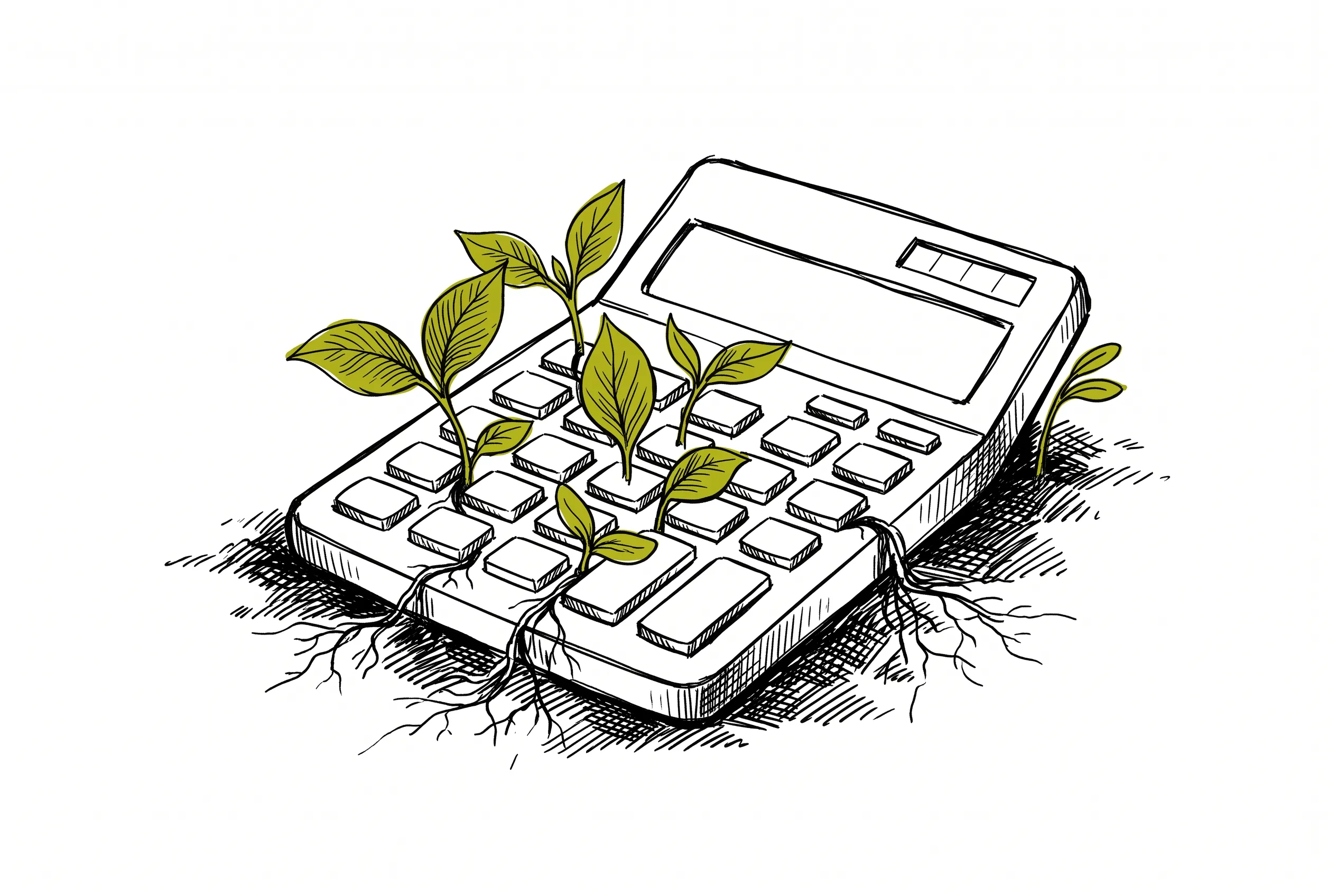
It is a gap we have decided to fill: Semisto is developing a French-language tool that calculates the financial return of an agroforestry project — yours, with your surfaces, your species, your sales channels, your subsidies. It will be part of Terranova, our platform. It is under development, with no promised date — but if you want to be notified at launch (or tell us what it absolutely must calculate), leave us your address: the first people to raise their hand will be the first to try it.
What this changes for you
If you carry a project — a farm, family land, a partial conversion — the ILVO study finally gives you a frame to reason with: which income streams, which investment, which subsidies, which unknowns. Handling that frame can be learned: designing a food system that stands up economically is exactly what we transmit in the Semisto curriculum — and what we put into practice when we design a project with you.
The question “can it make a living?” now has an honest answer: yes, under conditions — and conditions can be designed. Come and see.