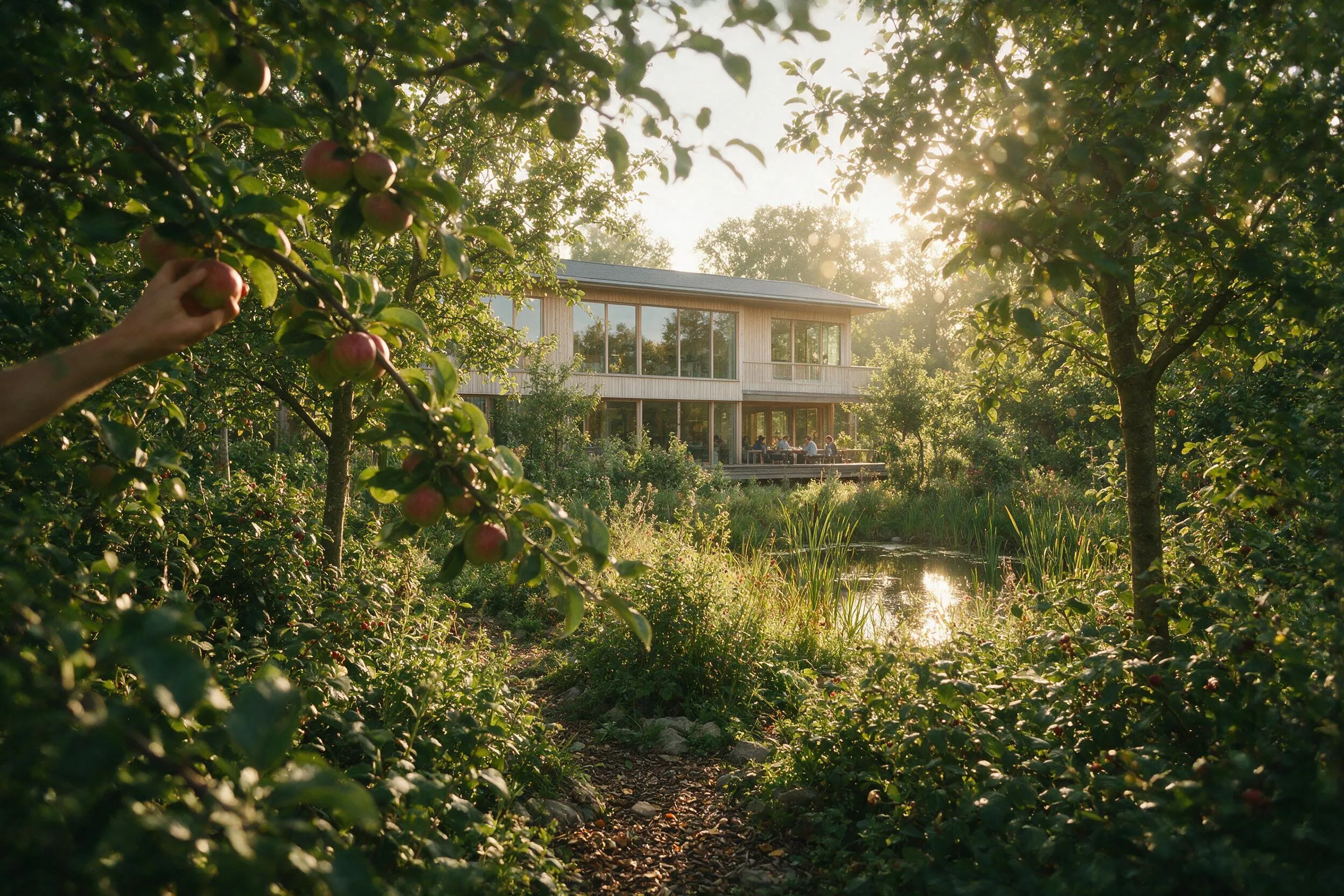
The corporate food forest: a guided tour of a typical project in Wallonia
A guided tour of a typical corporate food forest in Wallonia: pond, patio, chickens, harvests and coolness — a regenerative ecosystem around your offices.
Published August 4, 2026 · Semisto
It is 2:30 pm on a Tuesday in July. In the meeting room, the thermometer reads 29 °C despite the lowered blinds. Through the window you can see the car park, and around the car park, the lawn — immaculate, mowed this week. It cost its weekly mowing pass, as it does every week from April to October. And it gives you nothing back: not a single fruit, not one degree of coolness, not one reason to spend your break out there.
What if the outdoors worked for you?
At Semisto, we design food forests for companies. This article describes the project we dream of planting around your building — a fictional project, but a realistic one. The approach has a serious precedent: the Flemish institute ILVO assessed the economics of a food forest in exactly this way, on a fictitious but realistic case, because it is the best way to make tangible what does not exist yet. Every element described here already exists somewhere — it is only waiting to be brought together around your offices.
What your lawn is costing you
Let’s do the maths before the tour. A company lawn of 3,000 to 5,000 m² means weekly mowing from April to October — twenty-five to thirty passes a year, every year, in perpetuity. It is a recurring expense that produces exactly zero value: no harvest, no shade, no biodiversity, nowhere to sit. In a heatwave, it turns yellow and radiates heat back at your facades.
“But I have a robotic mower”: the objection is legitimate, so let’s face it squarely. The robot does eliminate the weekly pass, true — but it does not change the equation, it freezes it. A permanently mowed lawn is a desert that renews itself every night: no flower ever gets to bloom, no insect ever finds food, and the whole chain of life stops at the very first link. Hedgehogs, which roam at night when most robots are running, are its best documented victims. The robot fixes the cost line; it still creates no shade, no coolness, no harvest, no place to sit. The problem with the lawn was never the mower: it is that the lawn gives nothing back.
A food forest reverses this logic: an investment at the start, support during the first two years, then a system that asks for less and less and gives back more and more. The lawn is a cost that never pays itself off; the ecosystem is an asset that appreciates.
The tour: walk around the building
Picture a Walloon SME — about forty employees, a building, a car park, and those famous thousands of square metres of short grass. Here is the same site, three years after planting.
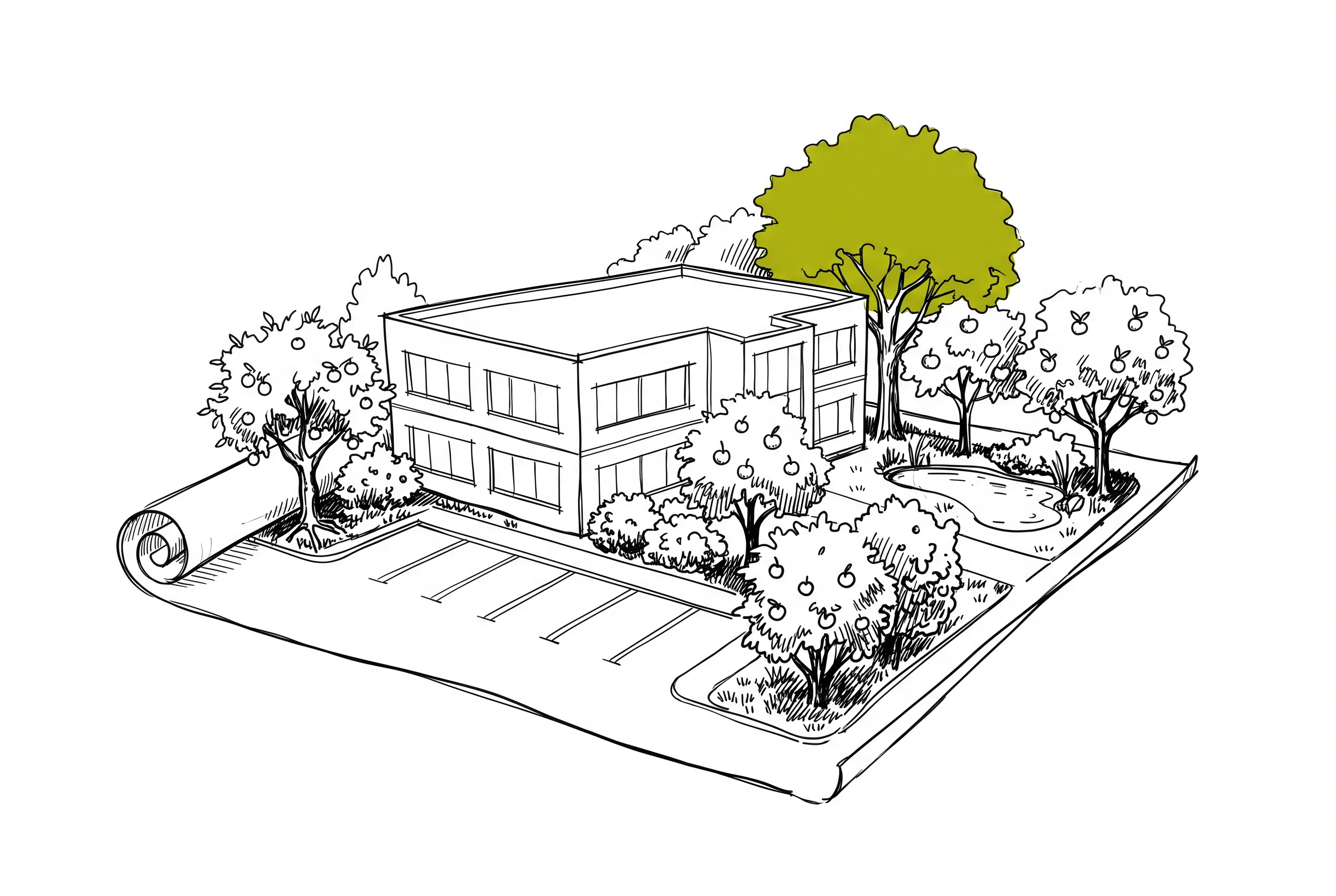
The car park edge
You park your car in the shade. Along the car park, a free-growing hedge of hazels, berry bushes and native shrubs has replaced the strip of turf. It absorbs the road noise, hosts the tits and chickadees, and in August you pick blackberries on the way back to your car.
The food forest, on the south-west side
Between the car park and the building, the most generous part of the system: full-grown fruit trees, berry shrubs, edible ground covers — the layers of a food forest, arranged to catch light at every level. Placed to the south-west, this grove does what no air conditioning can do: it intercepts the afternoon sun before it hits your facades, and the evapotranspiration of the foliage cools the air that reaches the building. Under the canopy, at the height of a heatwave, it is noticeably cooler than on the asphalt of the car park — it is physical, measurable, and you feel it the moment you step in.
The pond
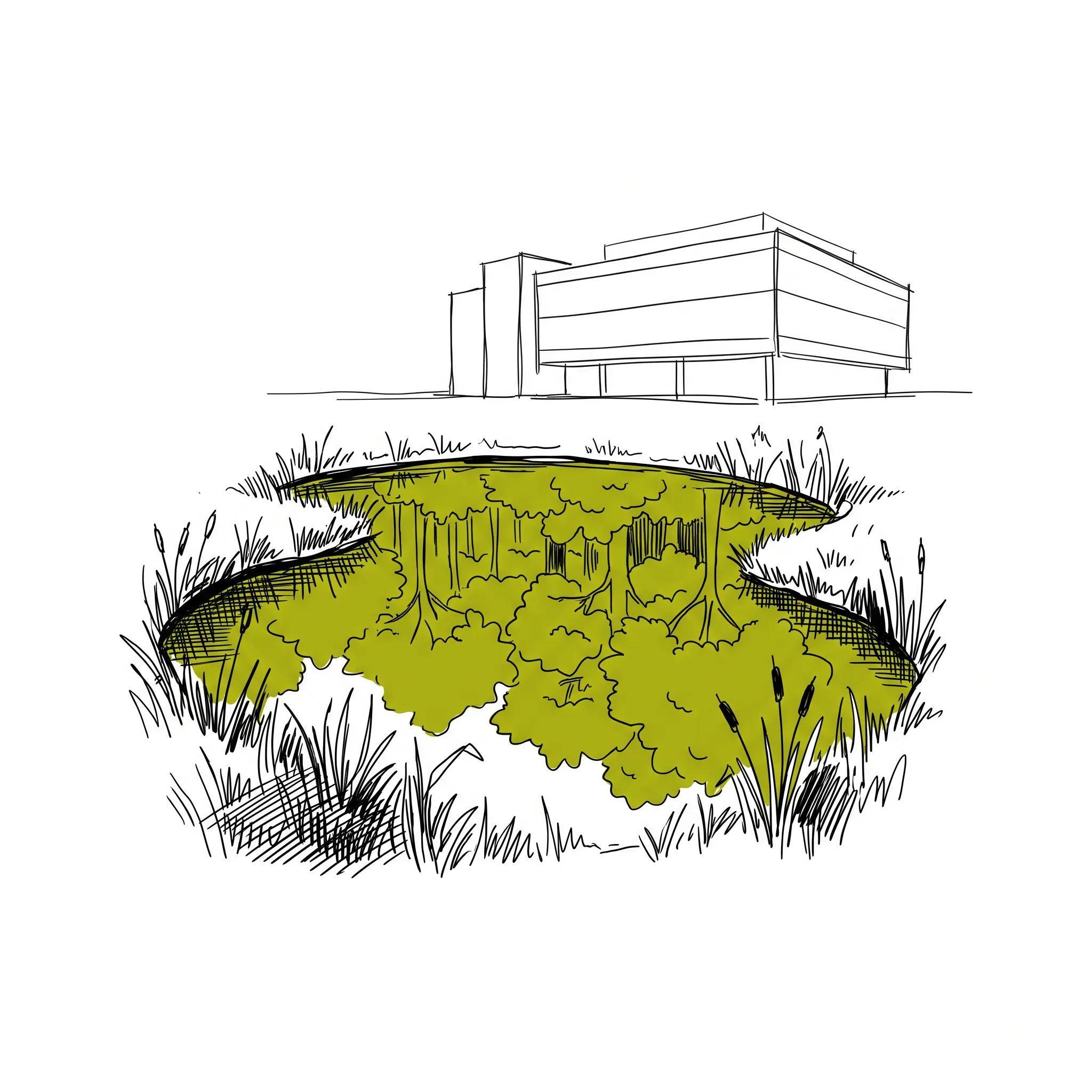
In the low point of the site, a natural pond collects the rainwater from the roofs. No pump, no blue liner: banks planted with reeds and irises, dragonflies from the first year, frogs from the second. It is the site’s cool spot and, very quickly, the place where people sit for the conversations that need calm.
The patio
At the heart of the garden, a wooden terrace with a large table. From May to September it is an open-air meeting room — the one everyone books first. Interviews are more relaxed there, brainstorms more alive. On Monday mornings, the team has coffee there among the birds.
The chickens
Near the kitchen, a henhouse and two or three chickens. The lunch leftovers go into their run instead of the bin, and come back as fresh eggs that employees share. It is the most modest element of the system and, curiously, the one everyone talks about. We have written about the role of chickens in a food forest — they do far more than lay eggs.
The meadow
Everything else — what used to be lawn — has become a flower meadow crossed by mown paths. You mow the paths, you scythe the meadow once or twice a year, and that is all. The grasshoppers, butterflies and wild bees do the rest.
A year in your food forest
In spring, the fruit trees blossom and the meadow lights up; the team eats outside from the first fine days. In summer, the patio becomes the company’s favourite room, the pond teems with life, and the first harvests circulate through the offices — raspberries, redcurrants, blackcurrants. In late summer it is the apples and pears that get shared around, and the blackberries from the hedge. Autumn sets the foliage ablaze, and winter reveals the garden’s structure — it is the planting season, often as a team planting day led by Semisto: there is no better team building than planting together the tree you will watch grow from your desk.
Let’s talk about maintenance
It is the objection we hear first, so let’s be precise. A food forest is designed to be frugal in maintenance — it is a design principle, not wishful thinking. During the first two years, the system settles in and needs regular care: watering the young plants in dry summers, mulching, adjustments. From the third year onwards, the order of magnitude drops to a few days of work per year — light pruning, coppicing the support trees, scything the meadow — against twenty-five to thirty mowing passes a year for the lawn it replaces. The system is designed so the soil feeds itself: fallen leaves, shredded prunings, nitrogen fixers.
And the chickens? Their setup is designed to run on its own: a well-protected run, an automatic door that opens and closes with the daylight, a feeder that takes over at the weekend. What remains is the weekday feeding — and experience shows it is not a chore: bringing the lunch leftovers to the chickens is a small ritual that builds a bond with the animals, and there are always employees who love doing it.
What it changes for your company
First, for the people: an outdoors where you want to be changes the working day. Breaks happen outside, meetings breathe, and the site becomes something people mention in job interviews. Then, for the building: shade and evapotranspiration soften the summer overheating, while the pond and the living soils absorb the storm rains. Finally, for your communication: at a time when every company must document its impact, an ecosystem planted at your address is the opposite of greenwashing — it is there, visitable, measurable. Tools even exist to track what a food forest produces, such as the Dutch participatory measurement programme documenting harvests, carbon, soil and biodiversity. And if your commitment also runs through patronage, ecological sponsorship is a complementary lever.
We have not yet planted this typical project in full — we tell you so plainly. But every one of its pieces, we have already planted. The food forest of the Queen Elisabeth Music Chapel in Waterloo brought edible nature onto the site of a renowned institution. At the Jardins d’ici in Naninne, alongside the local producers’ supermarket d’ici, 1,400 trees planted in 2023 are building a teaching food forest open to the public — and open to visits, if you want to see with your own eyes what a young system looks like.
What if we walked around yours?
This article has walked you around a building that does not exist. The next logical step is to walk around yours — the real one, with its constraints, its soil, its orientation and your teams. It is a one- or two-hour conversation, on site, with no commitment: we look at what your land makes possible, and you leave with a concrete vision of what it could become.
Tell us about your site — or come and walk the Jardins d’ici first, to feel what it is like: an ecosystem that works for the people around it.