100 € for twenty metres of hedge: Wallonia's planting grant is worth the paperwork
Open to everyone, private individuals included, and paid as a flat rate: what the planting grant can cover, on what conditions, and how to apply.
This article replaces the one we published on 27 August. It contained a calculation error, and not a small one: on the central point, we stated the opposite of the rule. The planting grant service of the Walloon public service (SPW) phoned us, took the time to explain, sent us its worked examples and reviewed our article. Our thanks to them. The good news is that the grant is considerably more generous than what we had written.
You have decided to plant this autumn: a hedge at the bottom of the garden, a few fruit trees, a bank to clothe. Here is what the SPW covers, on what conditions, and how to go about it, in order.
What stopped, what continues
Two schemes that everyone confuses.
What stopped: the batches of plants from Yes We Plant, supplied in kind to anyone who applied. 1,200,000 hedge plants have been allocated since 2020, and the scheme is closed.
What continues: the Week of the Tree, at the end of November, when the municipalities taking part hand out plants free of charge, in limited quantities and on varying dates. Ask yours.
What also continues, and is doing well: the planting grant. Its flat rates were raised in 2020, from 3 to 5 € per metre for a single-row hedge and from 12 to 25 € per orchard tree, and several of its conditions were revised in May 2024. That is the one that matters here.
You are entitled to it, farm or no farm
The grant is not reserved for farmers. Any natural or legal person, a private individual as much as a municipality, a province, a school, a non-profit or a company, can apply for land located in Wallonia, whether they own it, rent it or hold a right of use over it. If you are not the owner, you need the owner’s written and signed agreement. Two exclusions to know about: forest zones on the sector plan, and plantings imposed under a permit.
It covers five kinds of project: the live hedge, linear coppice, the orchard, the tree line and the maintenance of pollarded trees.
A flat rate, not a reimbursement
This is the point we got wrong, and it is the one that changes everything. The grant is an incentive, not a reimbursement of your expenses. The amounts are flat rates: when you do the work yourself, the SPW pays the flat rate, full stop. Your itemised invoices prove that you bought the plants; they do not cap the amount.
| Project | Flat rate when you do the work yourself |
|---|---|
| Live hedge | 5 € per metre for one row, 7 € for two rows, 9 € for three rows or more |
| Linear coppice | 1.50 € per metre for one row, 3 € for two rows, 4 € for three rows or more |
| Orchard | 25 € per standard tree of a listed variety |
| Tree line | 6 € per nursery-bought tree, 2 € per willow cutting |
| Pollarded trees | 20 € per tree over 30 years old that is pollarded |
When a specialist company does the work, the flat rate is increased by half. That is where, and only where, a ceiling comes in: the grant cannot exceed 80% of the total invoices, labour, plants and supplies included.
Four examples, supplied by the SPW’s planting grant service, for a single-row hedge whose plants meet all the award conditions as defined in the handbook:
| Single-row hedge | Who does the work | Invoice | Grant |
|---|---|---|---|
| 20 metres | you | your plants | 20 × 5 € = 100 € |
| 20 metres | a company | 200 € incl. VAT | 20 × 5 € × 1.5 = 150 €, below the 160 € ceiling: 150 € |
| 100 metres | you | your plants | 100 × 5 € = 500 € |
| 100 metres | a company | 800 € incl. VAT | 100 × 5 € × 1.5 = 750 €, capped at 80% of 800 €: 640 € |
The rule is the same for every kind of project. One exception: pollard maintenance, where there is nothing to buy, needs no invoice.
Let us redo our calculation. Twenty metres of country hedge, one plant every 70 centimetres at most: around thirty plants at least, forty if you plant tightly. Bare-root, a young native whip costs between 0.90 € and 1.20 € each when bought in batches, a little more individually, according to public price lists from Belgian nurseries surveyed in August 2026. Count 30 to 50 € of plants. The flat rate is 100 €. It pays for the plants, the mulch and the rabbit guards, and leaves you enough for the gloves.
(SPW examples and our own calculation on the published scales. A worked example, not your file.)
The conditions, and why they exist
Each project has its technical conditions. They are published in the SPW’s handbook, and they make sense: the SPW does not subsidise a fence, it subsidises a habitat. For a garden, the thresholds are within reach.
The live hedge. Twenty metres at least in residential zones and rural residential zones, one hundred metres elsewhere, in sections of at least twenty metres. At least three species, none exceeding half the plants. At least two thirds of the plants chosen from the insect-pollinated species on the list. One plant every 70 centimetres at most in the row, 70 centimetres to 1.50 metres between rows. Species from the list set out in the handbook’s annex, protection against livestock or game where needed, biodegradable mulch or none. The list has more than sixty species, from whitebeam to guelder rose. Hornbeam and beech do not carry the “insect-pollinated” asterisk there: keep them for the remaining third.
The orchard. At least fifteen trees, as standards: the trunk is at least 1.80 metres, which rules out garden bush forms. At least five varieties, none exceeding 40% of the trees, and three quarters of the trees in the heritage varieties listed in another annex of the handbook. Eight to forty metres between trees, in every direction, existing trees counting towards the spacing. A stake for two years. The cap of two hundred trees per year and per beneficiary was dropped in May 2024.
The tree line. At least twenty trees, in sections of ten, trees already in place allowed to count. Eight to fifteen metres between them, 1.20 metres tall at planting, a stake for two years, at most one hundred trees per hectare.
Linear coppice. At least one hundred metres, in sections of fifty. Three species, none exceeding half. At most two metres between plants, three metres between rows.
Pollarded trees. At least ten trees, over thirty years old and not cut for ten years. At most thirty trees per year.
For a garden, the twenty-metre hedge is often the first door. An orchard of fifteen standards fits on a large plot, a line of twenty trees follows a path or a boundary, and the trees already there count. None of this is reserved for a farm.
In order: prior opinion, planting, application
The calendar surprises people, because it can run backwards: you apply after planting. But the SPW has provided a way not to plant blind.
- The prior opinion. Optional, free, online via Mon Espace. You describe your project and the planting grant service tells you whether it is eligible. The SPW recommends it, and so do we: this is the moment to correct the species list or the spacing, not afterwards.
- Planting. Keep your invoice, made out in your name and detailing the number of plants per species and variety: without a detailed invoice there is no grant, even if the planting meets every condition. It is one of the main conditions of the file. If a company does the work, its invoice details labour, plants and supplies. Take at least four photos from different angles, showing where the planting sits and the spacing.
- The payment application. Within six months after the end of the work, online, with the invoices (less than two years old), the photos, a bank account certificate, the owner’s agreement if that is not you, and the planning permit if there is one. The grant is paid once the file has been checked, if every light is green.
You plant in November 2026: you have until May 2027 to file. You can mix plants received at the Week of the Tree with plants you bought: only the invoiced plants go into the grant application.
What the Nature and Green Spaces Directorate (DNEV) asks in return fits in one sentence: keep the planting alive for thirty years, from the end of the work, with at least 80% of the plants taking and the planting in good condition. No plant-protection products within a metre of the plants, no cutting between 1 April and 31 July, except wild cherry and walnut. The service may inspect, and if an inspection fails the principle is to bring things back into compliance: you are asked to put the planting right, and repayment only comes into play if nothing is done within the year. For a hedge, thirty years is the normal horizon.
For any specific case, the service answers by email at subventions.plantations@spw.wallonie.be, and Natagriwal’s advisers support farmers’ projects on 081 64 96 40.
And the food forest?
A whole food forest, with its mixed layers, tight densities and free choice of species, matches none of the five projects. But the grant can fund its backbone. The country hedge along the edge, the tree line along the path, the standards that will form the upper layer: each of these, if it meets its own conditions, qualifies for the flat rate. The dense heart remains at your expense. That is how to build the budget: with this line for the edge, without it for the heart.
Where to find your plants, and why now
This summer left a mark. In a written question of 20 August 2026 to minister Anne-Catherine Dalcq, MP Eddy Fontaine states that “nurseries have suspended transplanting because of the lack of water” and reports losses exceeding 10% on young plantings, with several growers mentioning 50%. No ministerial answer has been published yet: these are the MP’s findings, not the administration’s. A whip transplanted today is sold in two to three years. If that transplanting was missed, the supply of 2028 and 2029 could tighten.
Hence the advice: order your plants early. Nurseries and buying groups take orders until October. From a small local nursery, you also gain provenance, species chosen rather than endured, and the advice of someone who knows your region.
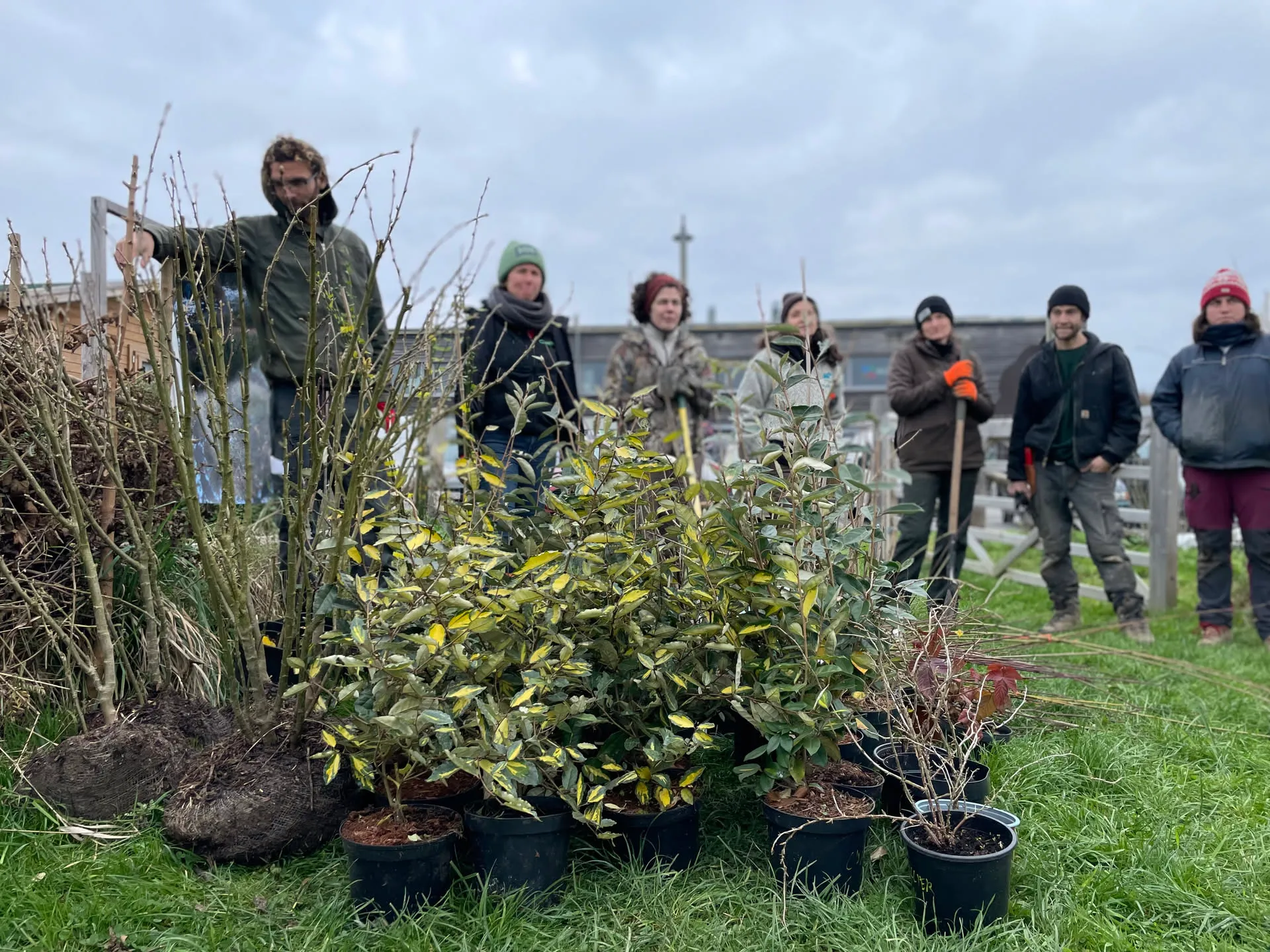
Four questions do the sorting. Where were the plants raised? Are they offered bare-root, cheaper than containers, available from November to March? Can a variety be grafted on request? And is there stock left for next winter, or must you already book for the one after?
Where you start
You have a garden. Measure your run. From twenty metres in a residential zone, it is best to ask for the prior opinion before you order: the file is worth it, whether you plant yourself or have it planted. Below that, plant freely, and choose your species for pleasure.
You are carrying a school, neighbourhood or collective project. The length is often there, and a planting day welds a group together. First check who owns the land: without written agreement, no file.
You are a municipality. The procedure is the same as for a private individual, and other, more specific subsidies come on top. We have documented the full approach in our offer for towns.
You are a farmer. This grant is for you too: a good share of the files come from farms, and some agricultural aids can be combined with it. The eco-scheme and the per-hectare calculation are covered in this other article.
November is coming, the best moment of the year to put bare roots in the ground. The SPW gives what you plant a helping hand, and it does so simply. Take it at its word.
For a look at your land before you order, there is our food forest coaching for those who plant with their own hands, and the design studio for a project drawn from end to end.
Come, we will show you.
Sources
- Walloon Government decree of 8 September 2016 on grants for planting hedges, coppice, orchards and tree lines, consolidated version in force since 15 April 2024: https://wallex.wallonie.be/eli/arrete/2016/09/08/2016027276
- Procedure “Demander une subvention pour la plantation d’une haie vive, d’un taillis linéaire, d’un verger et d’alignement d’arbres”, Wallonie.be, updated 23 July 2026: https://www.wallonie.be/fr/demarches/demander-une-subvention-pour-la-plantation-dune-haie-vive-dun-taillis-lineaire-dun-verger-et-dalignement-darbres-ainsi-que-pour-lentretien-des-arbres-tetards
- Handbook “Plantation d’une haie vive, d’un taillis linéaire, d’un verger et d’un alignement d’arbres et entretien d’arbres têtards”, SPW, May 2024, January 2026 edition, “Formulaires” tab of the procedure above.
- Worked examples supplied by the SPW’s planting grant service, email of 3 September 2026.
- Yes We Plant, “Plants” page, consulted on 26 August 2026.
- Written question no. 657 of 20 August 2026 from MP Eddy Fontaine to minister Anne-Catherine Dalcq, Parliament of Wallonia.
- Public price lists for bare-root young plants from a Belgian nursery, surveyed on 26 August 2026.