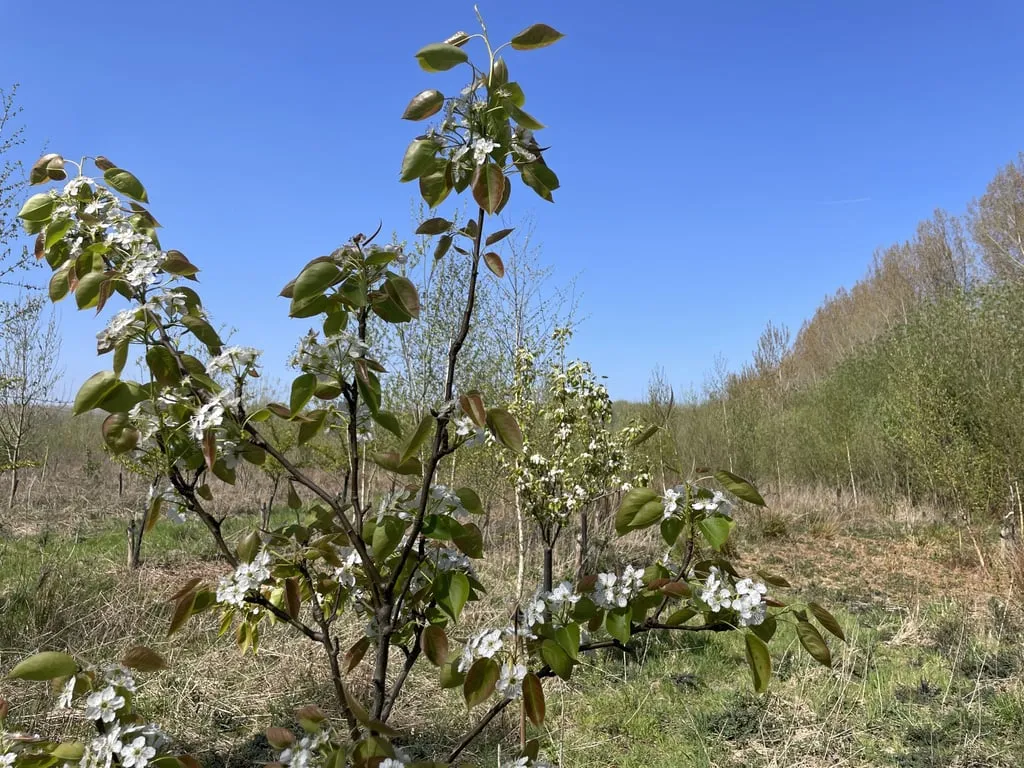
The Schijndel food forest: a model for Europe's agricultural future
In Schijndel (the Netherlands), a 20-hectare food forest tests a profitable farming model — and the Dutch legal framework that made it possible.
Published June 14, 2025 · Semisto
The Schijndel food forest: a model for Europe’s agricultural future
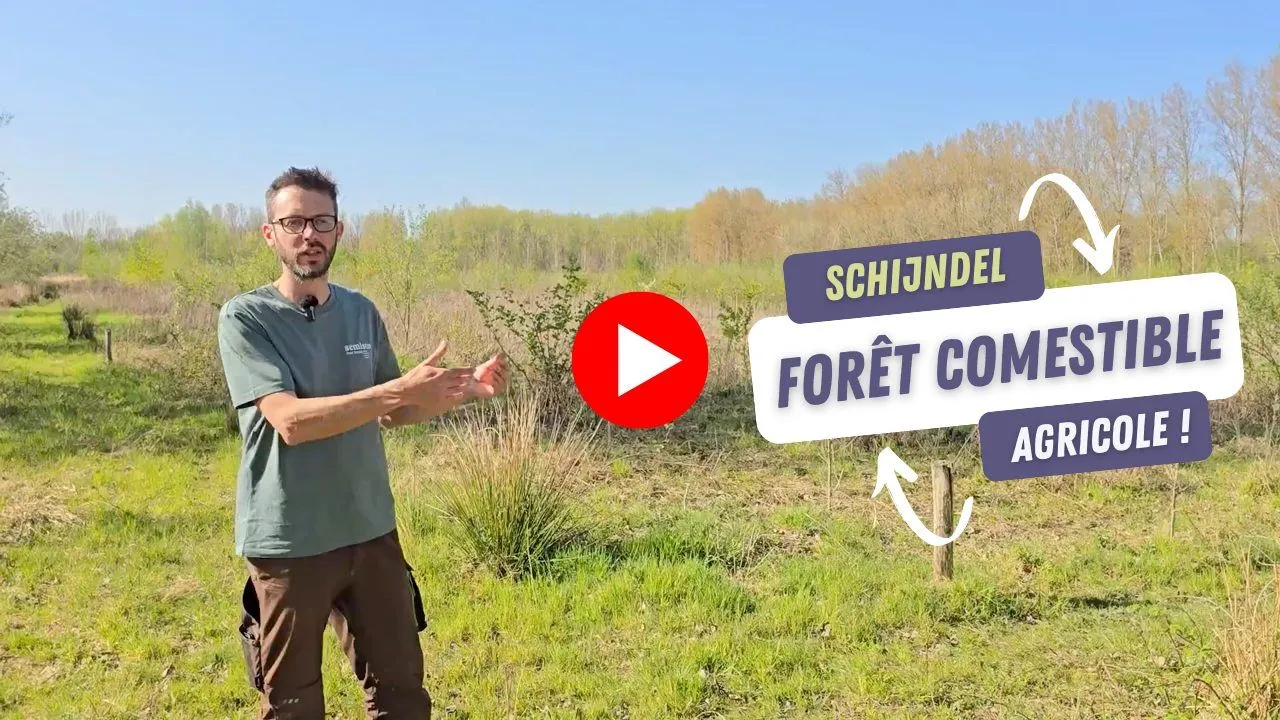
What if the food forest weren’t just a passionate gardener’s dream, but a full-fledged agricultural model? In Schijndel, in the Netherlands, that’s exactly what the Voedselbosbouw Nederland Foundation has been testing since 2019, on a 20-hectare plot. The ambition: to prove that a food forest can be profitable, productive and ecologically sound.
An agricultural answer to 21st-century challenges
The Schijndel project isn’t aiming for education or aesthetic demonstration, but genuine professional food production. Building on the Green Deal Voedselbossen signed in the Netherlands in 2017, it fits within a national strategic framework to develop a new generation of agroforestry — regenerative, economically viable and of high ecological value.
What is the Green Deal Voedselbossen?
Launched in 2017 in the Netherlands, this “green deal” brings together public institutions, scientists, companies and project leaders around a shared goal: supporting food forests as a recognised agricultural model. It eases access to farmland, funds pilot projects, structures scientific research and helps integrate food forests into national agricultural policy. Thanks to it, sites like Schijndel can get off the ground under conditions favourable to scaling up.
On farmland previously used for maize or ryegrass, the conversion is radical: the establishment of a productive forest ecosystem, designed on the principles of ecological succession and biomimicry. The food forest becomes a planned agroecosystem with multiple functions: food production, biodiversity habitat, carbon storage, climate resilience, and even recreation or education.
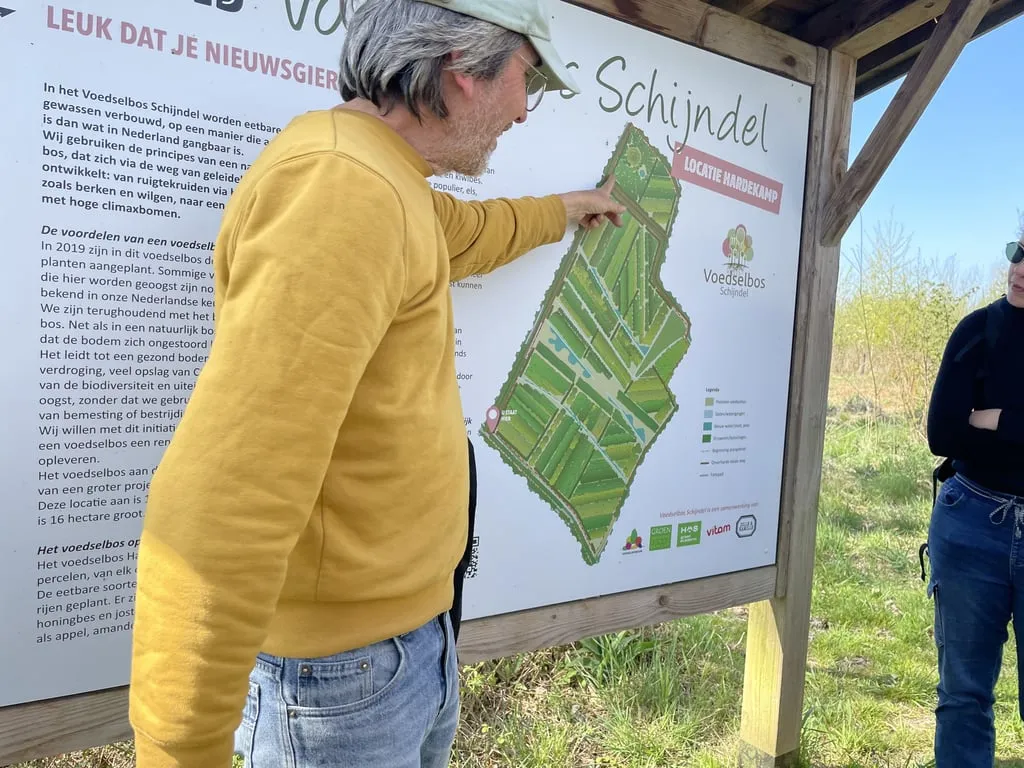
Rigorous design and built-in economic logic
The planting follows a rational approach:
- fine-grained analysis of soils and microclimates,
- earthworks encouraging biotope diversity (swales, mounds, hedges, wet pockets),
- planting of varied layers, mixing climax species like walnut or chestnut with fast-growing pioneers (alders, willows),
- integration of high-value edible species (blackcurrant, kiwiberry, wild garlic, plum, apple).
The plan expects gradual ramp-up, with profitability reached around year 7 and full economic maturity after 30 to 40 years. “Standard hectare” models are used to simulate yields, allocate crops, and maximise the system’s efficiency — all without chemical inputs or heavy mechanisation.
A long-term vision, backed by the numbers
The project is backed by solid partnerships:
- the province of Brabant, which owns the land, makes it available through a 20-year lease,
- the GOB (Groen Ontwikkelfonds Brabant) funds structural works and the initial planting,
- HAS Hogeschool supports research and scientific monitoring (biodiversity, profitability, carbon capture).
Financial projections confirm the long-term profit potential:
- first surplus year in year 7 (2024),
- full return on investment by year 14,
- gradually increasing yields through 2049 and beyond.
In practice, though, the project has had a few adjustments. Planting happened in successive phases from 2019: by the end of the 2022-2023 season, 11 hectares were planted with edible species, for more than 6,700 trees and shrubs (Stichting Voedselbosbouw Nederland). In 2026, Wouter van Eck estimated planting to be around 80% complete. This slip against the original schedule is due to technical, weather and logistical constraints — but doesn’t call the underlying momentum into question.
Produce is sold through short supply chains or processed (juice, compotes, teas, oils, etc.). Some of the output may also go toward experimentation, education or applied research.
A mosaic of functional landscapes
Two sites are involved in Schijndel: Boschweg (4 ha) and Hardekamp (16 ha), both bordered by natural areas. The design draws on food-producing landscape principles:
- varied hedges providing shade, biodiversity and wind protection,
- wet zones welcoming amphibians and beneficial insects,
- multiple layers with at least 4 vegetation strata (canopy trees, fruit trees, shrubs, ground covers),
- natural succession and non-intervention (no mowing or mechanical weeding).
This structural diversity is a lever for biodiversity: pollinators, birds, small mammals and fungi find refuge and food in this semi-wild, productive environment.
A living laboratory for regenerative agriculture
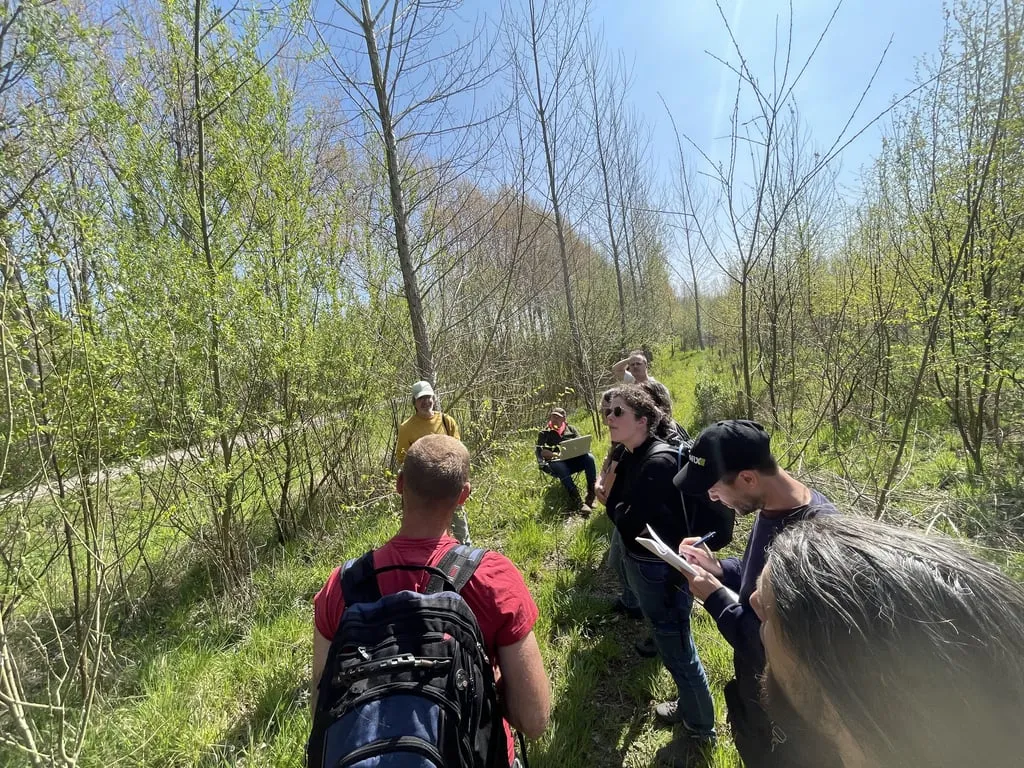
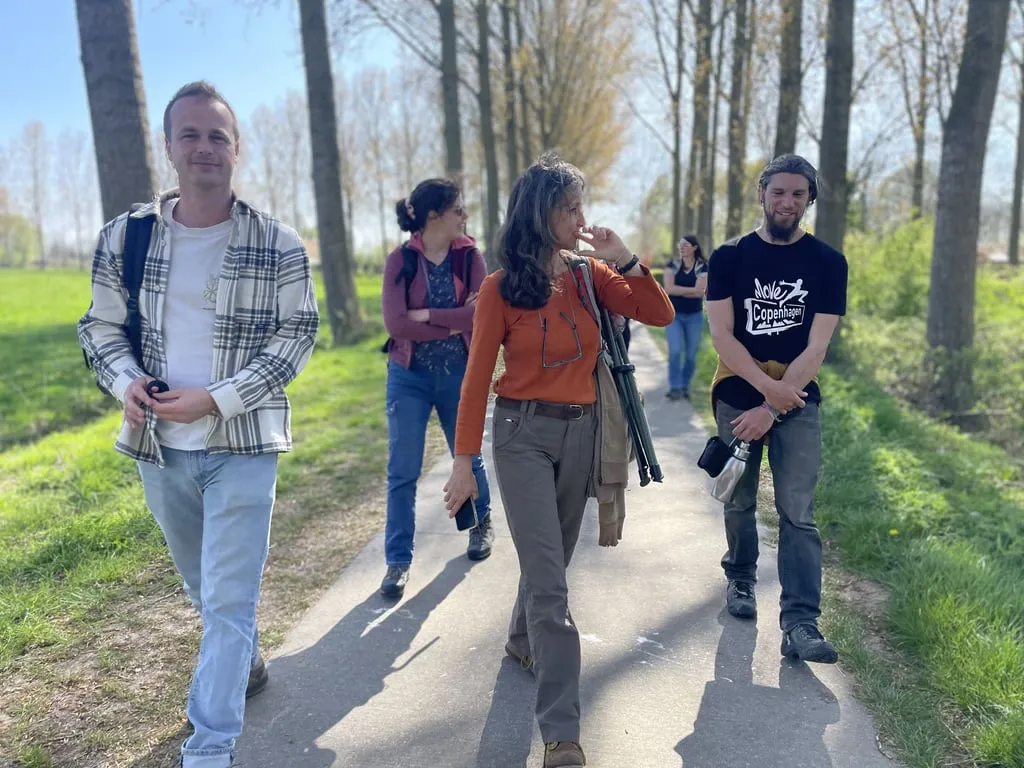
Schijndel is more than a field project: it’s a pilot site for a new vision of agriculture, at the crossroads of science, practice and education. Students, researchers, volunteers and farmers are involved in a spirit of co-creating knowledge.
It’s also a deeply strategic project: demonstrating that it’s possible to reconcile food production with ecological restoration, addressing economic and social challenges by working with natural dynamics rather than fighting them.
Update, July 2026: what makes Schijndel possible
We came back to this article a year after publishing it, with a precise question: what, in the Netherlands, allowed a project like Schijndel to exist — that Belgium doesn’t have? The answer has less to do with agronomy than with law. And it’s directly useful to anyone who wants to shift the lines in Wallonia and Brussels.
Why 20 hectares, and not two
The site’s size isn’t a whim of ambition. It follows from the official definition set out in the 2017 Green Deal Voedselbossen, which fixes a minimum size of 0.5 hectare in an ecologically rich setting, and up to 20 hectares where the starting environment is severely depleted. Schijndel began on former conventional fodder-maize plots: the bottom of the ecological ladder. Twenty hectares is the area the Dutch definition deems necessary for a productive forest ecosystem to self-organise in such a context.
That definition also states what a voedselbos is: a human-designed ecosystem modelled on a natural forest, with a canopy layer of tall trees, at least three other layers or niches, forest-type soil life, and a significant share of production intended for human food.
Let’s hold on to the mechanism, because that’s what matters: first a shared definition, then everything else.
The lock was legal, and the Netherlands unlocked it twice
In 2017, the Dutch state put in writing the very problem that Walloon farmers face today. Article 4 of the Green Deal commits the Ministry of Agriculture to seek solutions to the risk of “economic downgrading from farmland value to forest-land value” when exercising payment entitlements. In plain terms: planting densely means risking the loss of your plot’s agricultural status, and with it the CAP support.
Eight years on, that risk has been lifted — through two distinct and remarkably simple instruments.
First instrument: a crop code. The Dutch paying agency created the crop code 1940 “Voedselbos.” Under this code, the plot counts as agricultural area, is classed as a permanent crop, and the official record states in black and white that the crop is eligible for the CAP basic payment. The voedselbos is also an eligible activity under the Dutch eco-scheme. No change to European regulation was needed: an administrative code was enough.
Second instrument: a single line of provincial regulation. Dutch forestry law imposes a duty to report and replant as soon as you plant woody vegetation — a duty inherited from the 1961 Forest Act. The generic exemptions cover trees grown for their fruit, but not service trees: nitrogen fixers, nurse trees, willows and poplars. In other words, it isn’t the orchard that gets stuck, it’s precisely the layers that make a planting a food forest.
The province of Noord-Brabant settled the matter with a categorical exemption written into article 3.92 of its environmental ordinance, which frees from these duties any “woody stands forming part of an agroforestry system” — the text specifying elsewhere that the voedselbos is legally a form of agroforestry, not a forest. The exemption is conditional on maintaining a permanent agricultural designation for the plot.
A definition, an administrative code, one line of regional regulation. That’s the whole apparatus. And it’s transposable.
An honesty caveat. This lock is only lifted where a province has decided so: it isn’t a Dutch national exemption. Noord-Brabant chose the categorical exemption; Overijssel a case-by-case derogation. Moreover, the provincial subsidy and the replanting exemption appear, on a reading of the text, to be mutually exclusive — a point to confirm before presenting the two as a package.
What Brabant put on the table
The province didn’t merely remove a regulatory obstacle. It commissioned the demonstration. Wouter van Eck, co-founder of Stichting Voedselbosbouw Nederland, tells it plainly: it was the province of Noord-Brabant that asked the foundation to demonstrate that an agricultural food forest could be profitable, with a twenty-year lease, at the end of which someone else takes over the production.
The land arrangement deserves the attention of anyone thinking about the permanence of food-producing places. The Groen Ontwikkelfonds Brabant makes available, across its whole nature policy, 240 million euros and more than 3,000 hectares of land. For food forests specifically, a pilot launched in 2019 offered 22.5 hectares across five sites, allocated through a public procedure, for sale or lease — with the province remaining the owner. Since 2025, a provincial subsidy has been added: a flat €3,000 plus €11,000/ha, capped at €50,000 per project, from a one-million-euro envelope open until 2027.
A detail that matters for what follows: the province of Noord-Brabant had not signed the 2017 Green Deal. Only Flevoland and Limburg had. The most advanced province today, then, isn’t the one that signed the text, but the one that acted on land and regulation. Signing an agreement changes nothing; changing one line of regulation changes everything.
The results, in numbers
Growth. In March 2026, the Dutch central statistics office published the agricultural-census figures: farms declaring a voedselbos rose from 29 for 36 hectares in 2020 to 231 for 367 hectares in 2025. A tenfold increase in five years. Noord-Brabant leads with 50 farms and 77 hectares, ahead of Gelderland and Limburg. These figures count only food forests declared by a farm business: the real area is higher.
The national target. In a February 2023 letter to Parliament, the Dutch ministers for Agriculture and for Nature set a course: 25,000 hectares of agroforestry by 2030, of which 1,000 hectares of food forests. That leaves a threefold gap to close in five years — the target is ambitious, and the gap must be stated.
Carbon. The national food-forest monitoring programme, run at the Ministry of Agriculture’s request, measured the aboveground biomass of sites aged 1 to 28 years. The oldest food forest measured stores on average 325 tonnes of CO₂ per hectare after 28 years; at thirty years, the programme considers a range of 180 to 550 tonnes realistic. Taking the lowest estimate, that’s 6 tonnes of CO₂ per hectare per year, where an annual crop or a grassland show net-zero aboveground storage. On soil carbon, by contrast, the authors draw no clear trend — and say so.
Biodiversity. The most striking example comes from Ketelbroek, the food forest founded in 2009 by Wouter van Eck and Pieter Jansen on a former maize field, now home to around 400 species over 2.4 hectares. In 2017, a study compared, at equal area, Ketelbroek and the neighbouring De Bruuk nature reserve, managed as such for a century. The results as Wouter van Eck presents them: 23 breeding-bird species in the reserve versus 22 in the food forest, 49 nests on each side, 168 moth species versus 169. And on the number of moths captured, the gap clearly reverses: 1,411 in the reserve, 2,375 in the food forest.
A productive food forest less than twenty years old thus matches, on indicator species, a century-old nature reserve — and exceeds it in abundance. The explanation offered is simple: most reserves also have an agricultural past and a soil poor in organic matter, whereas the food forest accumulates biomass and spreads its flowering across the season.
A methodological note. These figures come from a 2017 study by students at Van Hall Larenstein, as presented by Wouter van Eck during a 2026 training session at Ketelbroek in which Semisto took part. We were unable to trace the original publication. For institutional use, the reference to cite is the Ketelbroek case study in the national monitoring programme’s report (2023). And that monitoring report, however solid, is not peer-reviewed literature: presenting it as such would invite easy rebuttal.
Economics. The same programme reports the case of a food forest yielding, twelve years after planting, €3,500 per hectare per year in net balance from food sales alone — well above the Dutch average for cereals, silage maize and grassland. This is a single site: an illustration, not an average, and we refuse to present it otherwise. As a comparative order of magnitude, Wouter van Eck puts the income of a hectare of ryegrass at around €300 per year.
On the market side, the signal is there: the Dutch chain Dille & Kamille has partnered with the Schijndel project and is preparing processed products under a “food forest” label. The De Nieuwe Winkel restaurant in Nijmegen builds its menu on Ketelbroek’s harvests. Demand precedes supply.
The lock isn’t where you think
This is the most useful conclusion of this work, and it’s counter-intuitive.
It’s often said that Europe prevents food forests by imposing a maximum of 100 trees per hectare, above which a plot ceases to be agricultural. That European limit existed — it no longer applies. It featured in a delegated regulation for the 2014-2020 period; for 2021-2027, the specialist scientific literature finds that no density cap is imposed on member states for eligibility to direct payments. The base regulation moreover explicitly places agroforestry systems within the agricultural area.
So it’s the states and regions that set their own threshold. The Netherlands created a dedicated crop code. Flanders settled on 200 trees per hectare. Wallonia stayed at 100.
Yet the Walloon agriculture portal contains an exception worth reading closely: fruit trees are included in the eligible area, regardless of their planting density. A fruit-dominant food forest could therefore, under current Walloon law, argue its eligibility without a single text being changed. The whole question becomes the definition of “fruit tree”: do small-fruit shrubs count? The lower layers? Forgotten species?
The same text specifies that a wooded area only falls out of the agricultural domain if three conditions are met: more than 30 ares, more than 10 metres wide, and less than 5 metres between crowns. A design in narrow strips, or with wider crown spacing, escapes that reclassification. It’s as much a design question as a lobbying one.
To verify before any meeting. The claim that the Union no longer imposes a density cap in 2021-2027 is the pivot of this whole line of reasoning, and we hold it from a solid scientific source rather than a direct reading of the regulation — which we could not extract word for word. We therefore publish it as a question put publicly to the Walloon administration, not as an established certainty. A written answer, favourable or not, will be worth more than any article.
What seems worth asking for
Four things, in order of increasing ease.
A definition. Nothing is built without one. The Netherlands began there in 2017, and everything followed. Wallonia has, to our knowledge, no official definition of the food forest.
A crop code. This is the most effective and least costly Dutch instrument: it requires no change to European law, only a regional administrative decision.
A written clarification on fruit trees. The exception already exists in the Walloon text. It’s enough to ask the administration how far it reaches, on a real plot.
An operational group. Flanders produced its guide to food forests in farming through a European operational group funded without any regulatory change. The same vehicle is available in Wallonia today.
Finally, an open door few people know about: Stichting Voedselbosbouw Nederland supports farmers through their transition — from five hectares, with a minimum five-year commitment, providing the plants and design expertise. Wouter van Eck indicates that this support is conceivable outside the Netherlands. For a Walloon farm ready to take the plunge, that’s no small thing.
And here at home?
We’re not waiting for a Walloon framework to exist before designing systems that will hold up when it arrives. If you’re carrying a project — a farm, a municipality, a plot looking for its purpose — let’s look together at what could be done with it, using the schemes that exist today.
And if you want to understand in depth how a food forest at this scale is designed, that’s exactly what we teach in the Semisto course — visits to Dutch sites included.
To go further
- Official website — Voedselbos Schijndel
- Voedselbos Schijndel project plan (2018)
- “In het grootste voedselbos van Europa komen landbouw en natuur samen” — Klimaatadaptatie Provincie Noord-Brabant, 2024
Sources for the July 2026 update — legal and policy framework
- Green Deal C-219 “Voedselbossen” — full text, 2017. The official definition is in article 2, the finding on agricultural downgrading in article 4.
- Crop code 1940 “Voedselbos” — RVO, the Dutch paying agency. The basic-payment eligibility mention is explicit there.
- Agroforestry and the CAP 2025 — RVO: how a densely planted plot still counts as agricultural land.
- Omgevingsverordening Noord-Brabant — article 3.92: the exemption from the replanting duty for agroforestry.
- Kamerbrief “Inzet op voedselbossen” — 2023: the target of 25,000 ha of agroforestry including 1,000 ha of food forests by 2030.
- “Oppervlakte voedselbossen in vijf jaar tijd vertienvoudigd” — CBS, March 2026: the agricultural-census figures.
- Report of the Nationaal Monitoringsprogramma Voedselbossen — Wendel, Rooduijn & Disselhorst, 2023: soil, biodiversity, biomass, business model. The Ketelbroek case study is on page 28.
- Provincial “Voedselbossen” subsidy and Groen Ontwikkelfonds Brabant — the land and funding scheme.
- Schijndel project page — Stichting Voedselbosbouw Nederland: areas, planting phases, partners.
- “Eligible hectare” — Walloon agriculture portal: the 100-trees/ha rule and the fruit-tree exception.
- Mosquera-Losada et al., “Policy challenges for agroforestry implementation in Europe”, Frontiers in Forests and Global Change, 2023 — on the disappearance of the EU-imposed density cap.
- “Agroforestry in the European Union” — European Parliament research service, 2020: 15.4 million hectares of agroforestry in the EU, of which only 358,000 on arable land.
- “Voedselbossen in het Vlaamse en Nederlandse beleid” — BOS+, 2023, and the FoodForward draaiboek — ILVO, 2024: the comparison with Flanders.