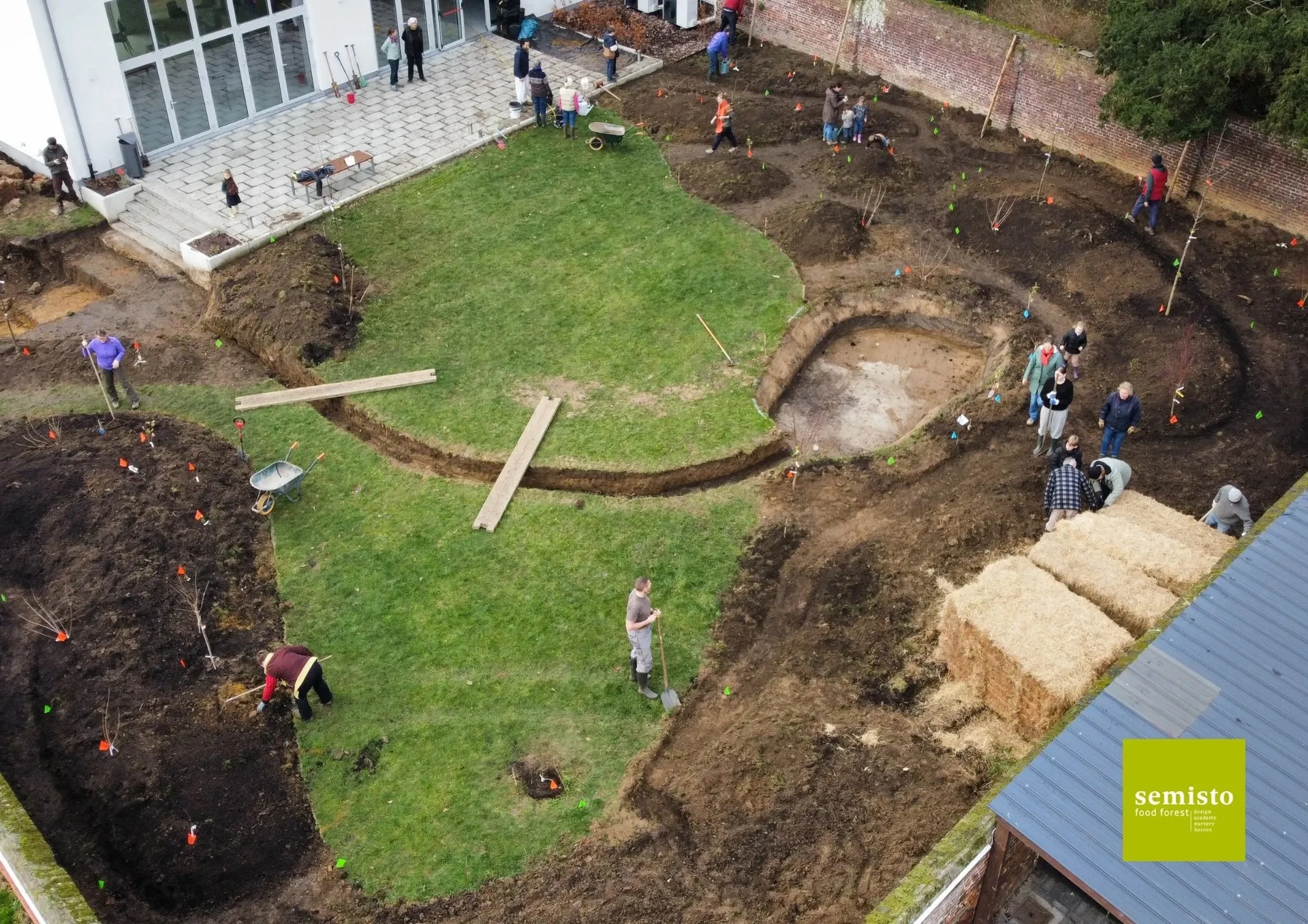
The food-producing forest garden of Tourinnes-la-Grosse
The first public food-producing forest garden in Walloon Brabant, designed with residents around the Maison de la Mémoire et de la Citoyenneté.
🏛️ Our first municipality. The first food-producing forest garden Semisto has designed in a public space, with a local authority.
A food-producing forest garden takes root in Tourinnes-la-Grosse
At the heart of Tourinnes-la-Grosse, around the Maison de la Mémoire et de la Citoyenneté, a new landscape is taking shape: a food-producing forest garden, designed with and for residents. The project was born within the Programme Communal de Développement Rural (rural development programme) and carried by the Commission Locale de Développement Rural (local rural development commission), in partnership with the Municipality of Beauvechain, the FRW and Semisto.
A food forest is an edible ecosystem inspired by the young natural forest: trees, shrubs, climbing plants, ground cover and root plants coexist across several layers, feeding people while regenerating the soil and supporting biodiversity.
In Tourinnes-la-Grosse, this food forest becomes a public food-producing garden, open to everyone, around the Maison de la Mémoire et de la Citoyenneté.
A pilot project
This is the first forest garden in the municipality, and in Walloon Brabant.
This site will serve as a testing ground to:
- learn together
- test planting and management methods
- document what works
- inspire other public or private sites in the area
A demonstration project
The MMC food forest is designed as a demonstration space:
- to concretely understand how plants interact with one another
- to visualise the structure of a multi-layered food-producing ecosystem
- to show how public green-space management can be rethought toward more resilient, more food-producing systems
Residents, elected officials, schools and associations will be able to observe, ask questions, draw inspiration, and leave with ideas for their own projects.
A food-producing project
Year after year, the food forest will produce ever more abundance: fruit, berries, leaves, seeds, roots, flowers…
These harvests are intended for:
- the municipality’s residents
- the events and activities organised in and around the community hall
- educational activities (workshops, visits, participatory work days)
A participatory design, rooted in the place
The project was built step by step, from a participatory design process bringing together the CLDR, the Municipality, the FRW and Semisto.
The site study took into account:
- the reference plan and on-site surveys
- sun exposure and microclimates
- wind, water and slopes
- circulation flows around the hall
- the views, history and context of this place of memory
This groundwork made it possible to place every plant in the right spot, in keeping with the life of the building and the garden’s future uses.
A wide diversity of edible plants
The MMC food forest is made up of several layers of vegetation, with a plant palette carefully chosen for its food-producing, ecological and educational value.
Trees include, among others: small-leaved lime, walnut, chestnut, almond, apple, pear, Burettes plum, peach, fig, pawpaw, persimmon, medlar, whitebeam, Sichuan pepper, jujube, Judas tree…
Shrubs offer a wide range of berries and resources: blueberry, blackcurrant, black chokeberry, honeyberry, gooseberry, sea buckthorn, dogwood, silverberry, goumi, goji, Damask rose, hibiscus, and more.
Climbing plants complete the picture: grape, kiwi berry, honeysuckle, hops, winter jasmine, passionflower, five-flavour berry, Caucasian spinach…
This diversity makes it possible to:
- produce harvests spread across most of the year
- create habitats for local wildlife
- concretely show what an edible forest in a municipal setting can look like
A living place for memory and citizenship
The food forest fits within the mission of the Maison de la Mémoire et de la Citoyenneté:
- an intergenerational meeting space
- a setting for civic and commemorative events
- an educational playground for schools, youth movements and associations
- a restorative backdrop for village events
After the planting work, the project continues: monitoring the plantings, building ponds, planting the lower layers, then the first harvests and propagating plants to spread elsewhere.
What’s next?
The Tourinnes-la-Grosse food-producing forest garden is meant to keep evolving over the long term.
Season after season, it will become:
- a living laboratory for the municipality
- an educational tool for understanding the challenges of food resilience
- a place of abundance and social connection serving the community
Semisto is supporting the Municipality of Beauvechain in making this project an inspiring example of turning public spaces into food-producing, regenerative systems, in resonance with its mission: turning landscapes into forest gardens and food forests in service of all living things.
Plans & photos of the project
You too can create a food forest
Individual, municipality or company — tell us about your project.