A food forest in the schoolyard
Schools in Flanders and the Netherlands are planting food forests in their playgrounds. What they harvest there — and how your school can follow.
Published August 20, 2026 · Semisto
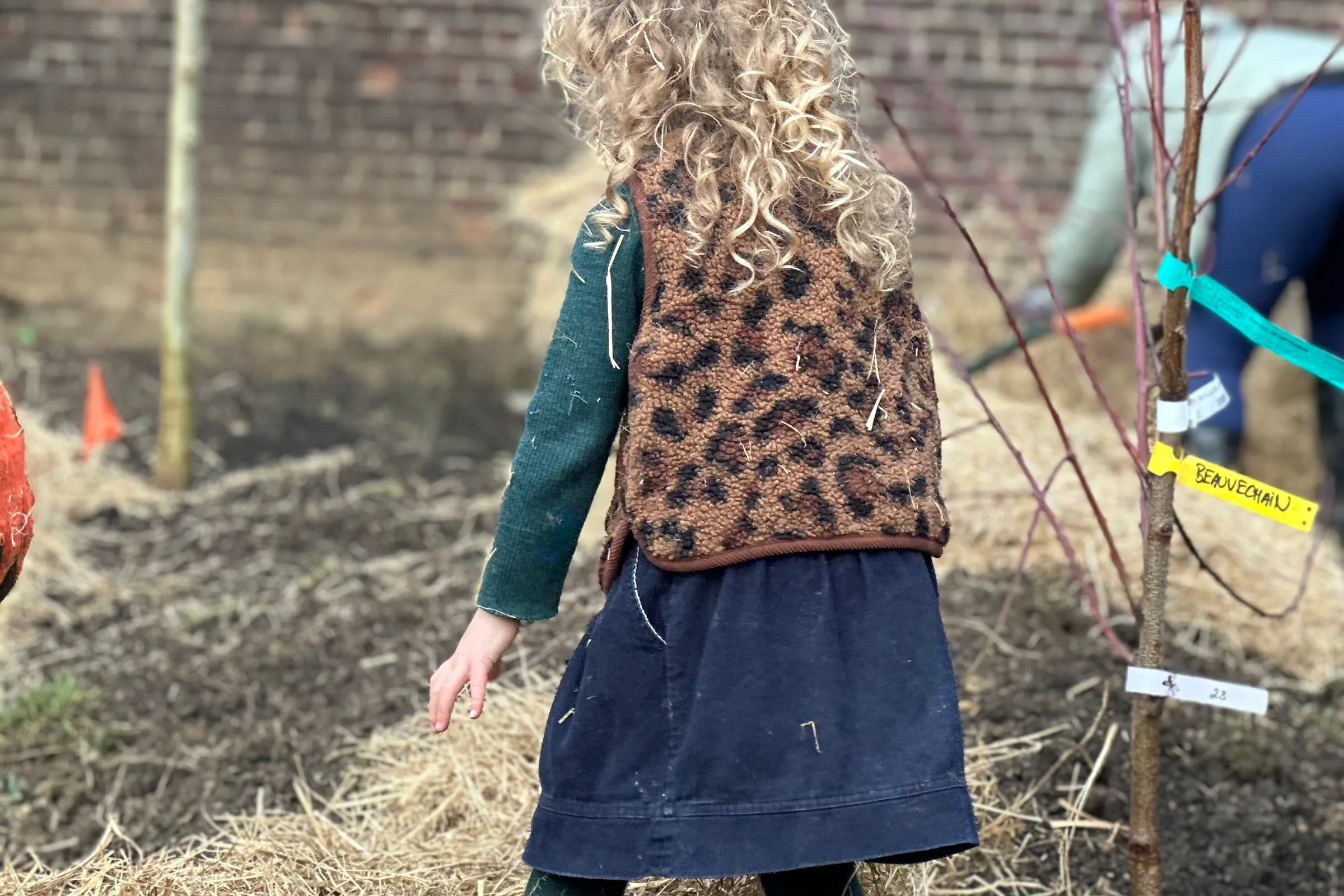
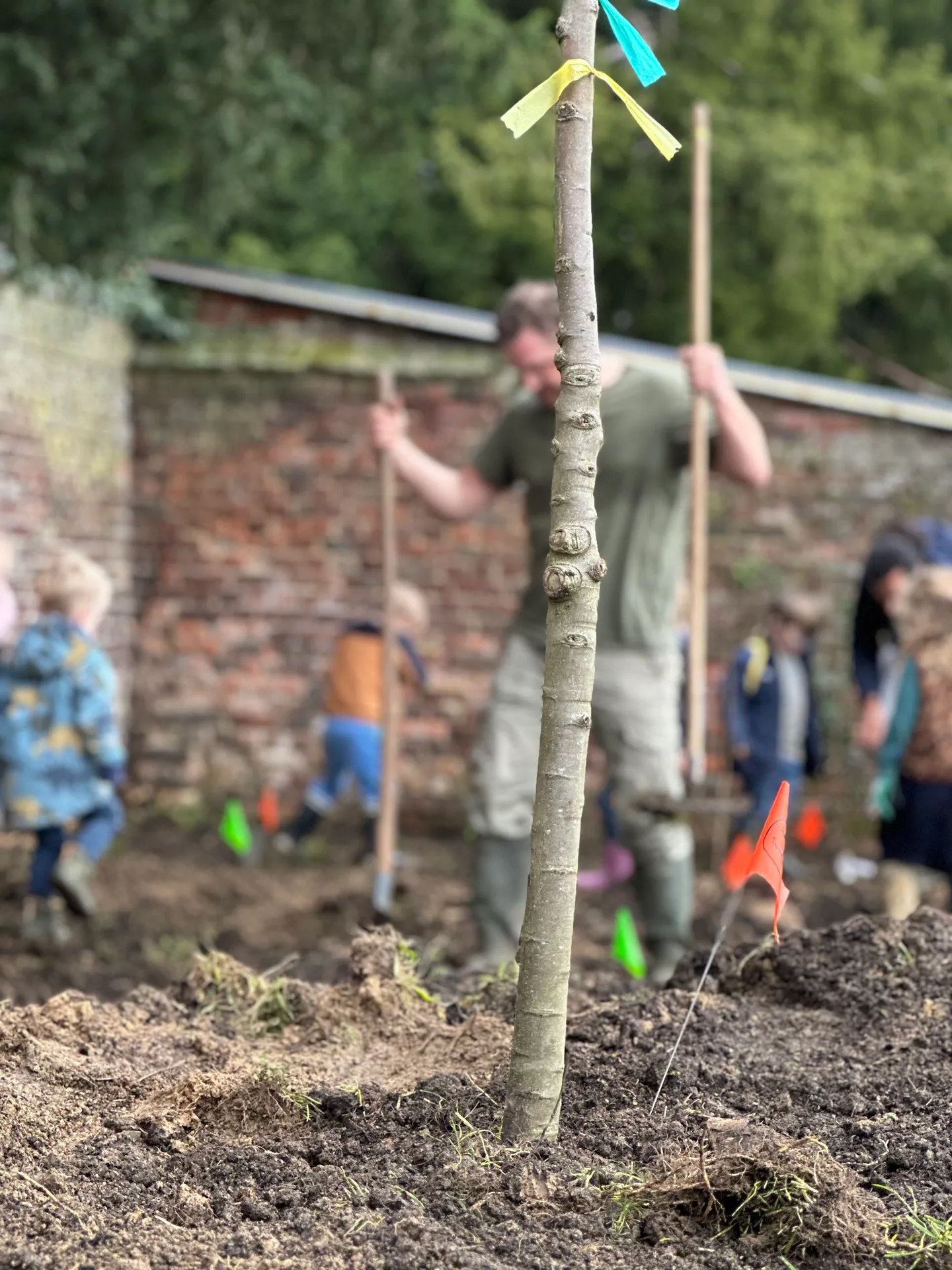
February 2025, Ardooie, West Flanders. The pupils of the De Zonnebloem municipal school are planting several hundred trees, shrubs and perennials in their playground: sweet chestnut, berry bushes, strawberries, thyme, lavender. The school had even bought and demolished a neighbouring house to make room. In a single day, a stretch of playground became a young food forest — one of the very first of this scale in a Belgian school.
Louis De Jaeger, the designer who guided the project, tells a story: during a school visit to the Royal Palace, not a single pupil in the class could recognise a stinging nettle. That story says where we are starting from — and why Ardooie interests us so much. At Semisto, we are convinced that a schoolyard is one of the most powerful places to plant a food forest: a few dozen square metres that touch hundreds of children, every school day, for decades.
What our neighbours are already planting
Ardooie is not an isolated case. The Belgian association GoodPlanet has been rolling out the “Snoepbosje op school” programme since 2024 — literally “little candy forest at school” — starting in Flanders, aiming for 500 primary schools in two school years, funded by the Colruyt Group’s foundation. The idea: a free kit to plant, on at least 12 m², an apple tree, a medlar, a currant bush, a raspberry, wild strawberries, a thornless blackberry and aromatic herbs. A genuine multi-layered system in miniature: tree, shrub, herbaceous layer, climber. A starter food forest, planted by the third-year pupils themselves.
The Flemish Region is pushing in the same direction: its “Natuur in je School” programme has supported some 360 depaving and greening projects in schoolyards since 2022 — 39 million euros invested and more than 25 hectares given back to the living world, with up to €150,000 per project.
In the Netherlands, the movement is a step ahead and runs on a well-oiled model. The IVN association installs standardised “voedselbosjes”: 30 m², around thirty edible perennial species, from almond to quince to lemon balm. One of the first was planted in November 2020 at the De Valk school in Lunteren, a first for its municipality. Today they are growing everywhere from Rotterdam — where the school pays a one-off contribution of €1,500, design, plants and workshops included, the rest carried by the city and foundations — to North Brabant, where some thirty schools joined in eighteen months. Timo Roordink, head of the Lunteren school, sums it up: the food forest offers “very powerful teaching, through real-life experience”. The children mostly remember that they love the cola herb “because it smells so good”.
Elsewhere in Europe, the same wave is rising under other names. In Paris, 203 “cours oasis” have been depaved and planted since 2017, with up to 8 °C less measured in the transformed playgrounds. In the UK, Trees for Cities has created 216 “Edible Playgrounds”, edible schoolyards woven into the curriculum. In Germany, “Grüne Schulhöfe” competitions depave, shade and green.
And here in Wallonia?
Wallonia is no laggard on greening: the “Ose le vert, recrée ta cour” campaign, run by GoodPlanet and Natagora with the Walloon Region, has received more than 1,300 applications from schools over five editions — 106 schools supported in the 2024-2025 edition alone, with a grant of around €2,000 and personalised guidance per school. In Brussels, the “Ré-création” operation has committed more than 5 million euros to transform some forty overheating playgrounds. And the free “Un Bois Gourmand à l’école” kit — the French-language version of the Snoepbosje — is open to primary schools across Belgium, Walloon ones included. The demand from schools is there, and it is massive.
But in all of this, the food forest proper — the multi-layered edible system designed to last for decades — remains the exception. We depave, we plant shade trees, sometimes a vegetable garden or a few fruit trees: an excellent first step, which proves that schools and public authorities want to move. The next step, the one Flanders and the Netherlands are climbing right now, is still waiting for its pioneers in Wallonia.
What research already measures
From one country to the next, studies on green schoolyards converge.
In the Netherlands, the team of Janke van Dijk-Wesselius and Jolanda Maas followed children aged 7 to 11 for two years as their school greened its playground: better attention restoration after break time, better social well-being, and a marked effect on girls’ physical activity. Louise Chawla and her colleagues showed that nature corners in schools work as stress refuges for children. Ingunn Fjørtoft’s pioneering work established it as early as 2001: playing in a natural environment develops motor skills, balance and coordination significantly more than a conventional playground. And a synthesis of 48 studies published in the Review of Educational Research concludes that garden-based learning improves school results — first and foremost in science.
Add the climate evidence: dark asphalt exceeds 60 °C at the surface on a summer’s day, while living, shaded ground remains usable. Every June or September heatwave puts the same question to school heads: what if break time happened in the shade of trees?
Why a food forest, and not just trees?
Everything above already argues for greening. So why go all the way to a food forest? For three reasons rooted in its very nature.
It is made of perennials. The Achilles heel of the school vegetable garden is known to every teacher who has tried one: it peaks in July and August, when the school is empty. A food forest lives to the rhythm of the school calendar: strawberries and the first raspberries in June, autumn raspberries at the start of the school year, apples, pears and hazelnuts in September-October, planting in November. The children are there at the right moments. And once established, it needs only light maintenance — not weekly weeding resting on the exhaustion of two motivated teachers. Let’s be honest about one thing: for the first two or three summers, while the roots reach down, a few watering sessions will need organising during the summer holidays. Rotterdam has planned for this from the start — every school there appoints a caretaker and commits for several years — and a relay of parents or neighbours does the job very well.
It is multi-layered. A shade tree cools. A food forest cools and feeds and shelters birds and insects and soaks up rainwater and offers hiding places, textures, smells, seasons. It is a complete ecosystem at child height — the densest teaching resource there is, from the water cycle to pollination, without leaving the playground.
It grows with the children. This may be what moves us most. A child who starts nursery school the year of planting will leave primary school ten years later, the year the trees start to bear seriously. The hazel planted at their eye level will tower three metres above them. Year after year, one workshop per class is enough — planting in nursery school, observing and tasting in primary, pruning and propagating with the older ones — for every child to weave a long relationship with the same living place. No other piece of school equipment does that: everything else wears out over the years, the food forest gains value.
Louis De Jaeger puts it bluntly about his pioneering school: “It’s not expensive, it’s not difficult, you just have to do it.” A starter module fits in 25 to 100 m². Most playgrounds, even urban ones, have that — as concrete to break up or as a lawn with nothing to do.
What if your schoolyard became a food forest?
At Semisto, we design food forests and train the people who bring them to life — exactly the duo a school needs: a well-designed place, and adults equipped to animate it year after year, from nursery to the end of primary school.
Are you a teacher, a head, a parent, a member of a school board or a municipality, and a playground comes to mind as you read these lines? Write to us. We will come and see the yard and tell you what is possible there, including on the questions a school head rightly asks: which species to choose or avoid, how to deal with wasps and allergies, what the children taste and what they observe. And together we will imagine the planting day when your pupils get their hands in the soil.