Compost goes on top
Why we spread compost around new plants instead of mixing it into the planting hole: what fifty years of trials show, and how to do it at home.
Michael Hulet and Nova Published November 17, 2026


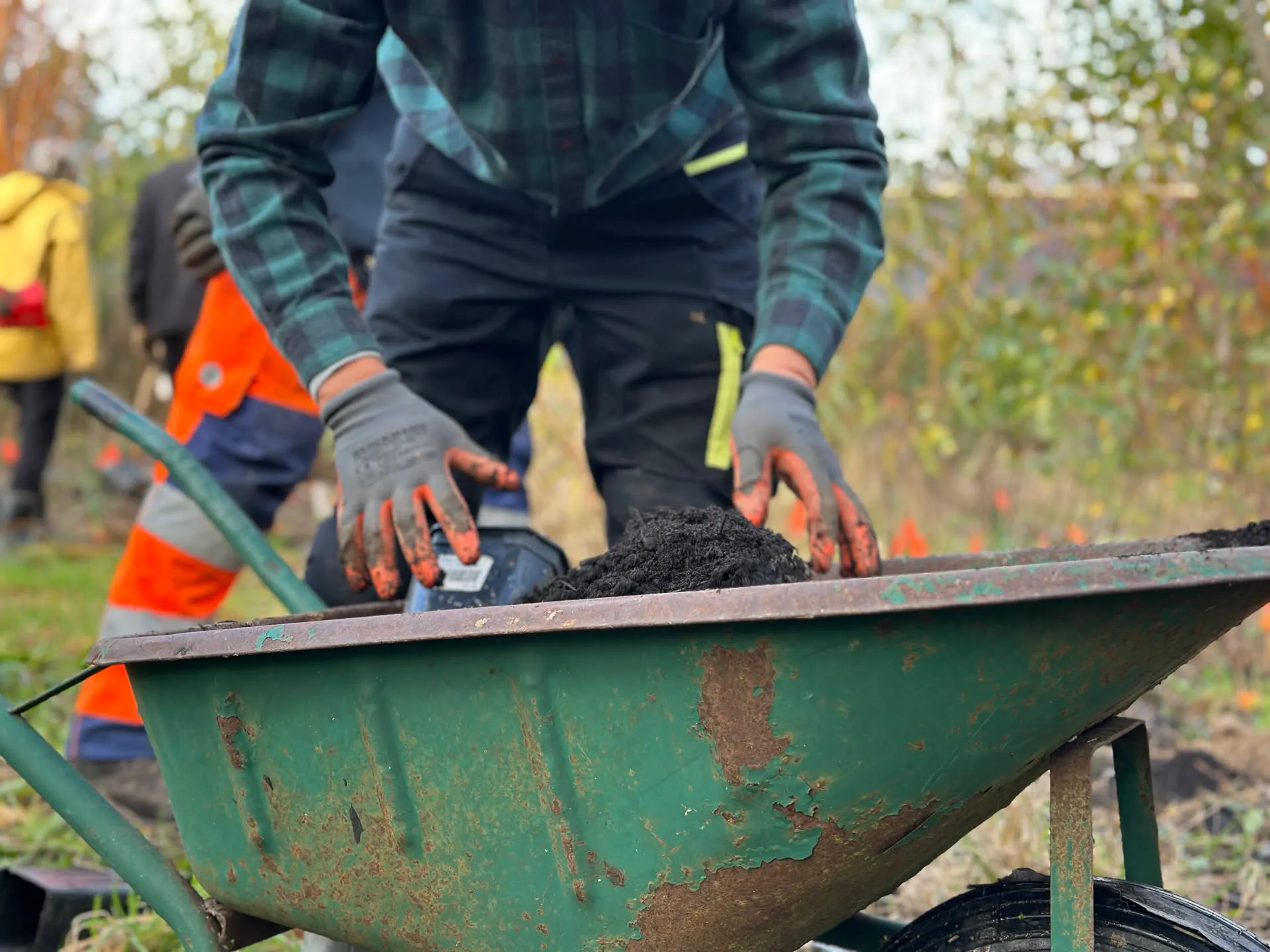
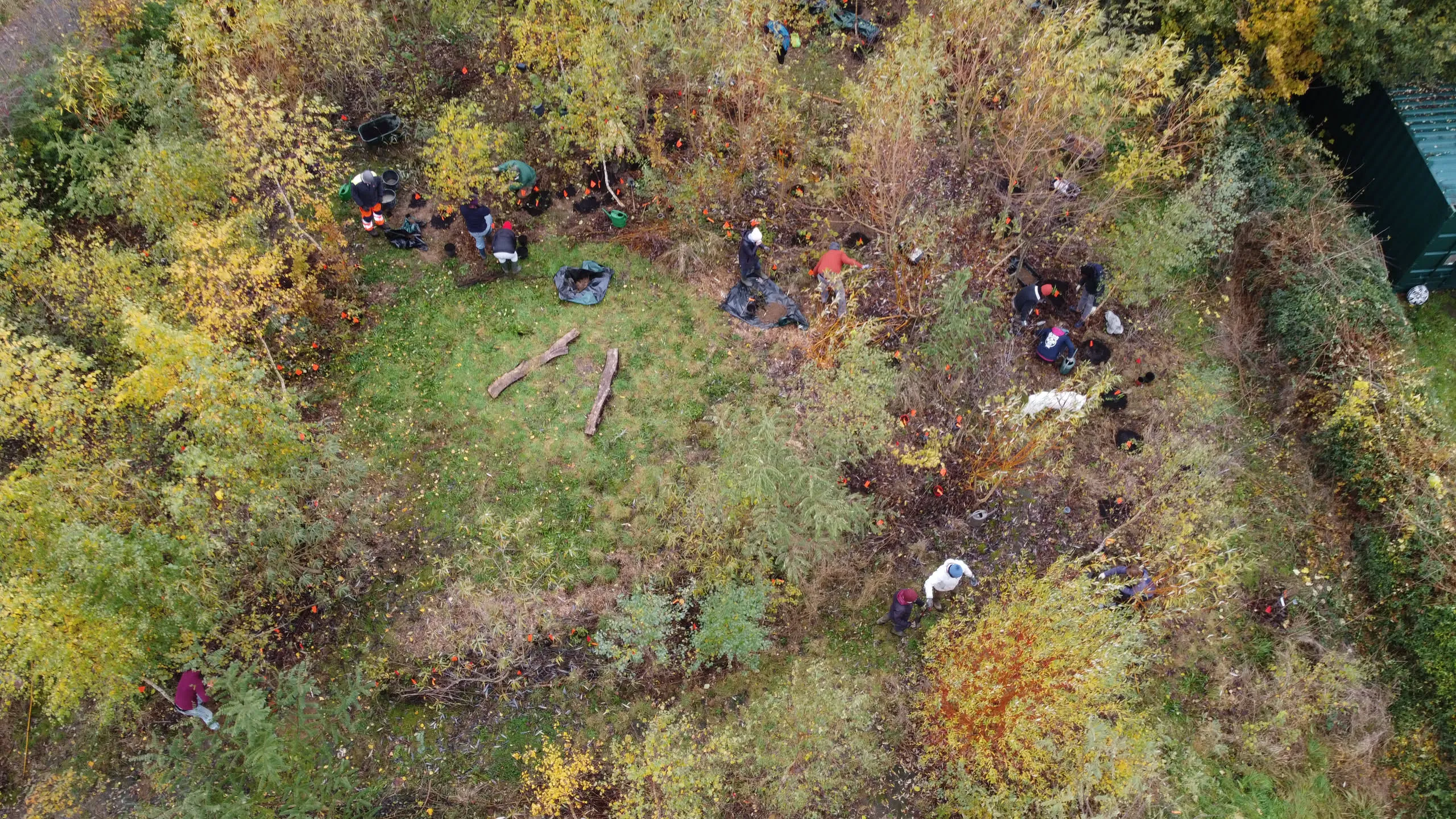
Sunday 15 November 2026, at the Naninne food forest. Under the birches and alders planted in 2023, little orange flags mark every planting spot. About thirty volunteers put 450 plants in the ground: a few shrubs, and above all perennials and ground covers. Valiant green wheelbarrows shuttle back and forth with a fine black compost, which we spread around each plant, a good five centimetres thick. Not in the hole. Over the hole. That is the technique François Delforge, our nurseryman, recommends, and he was leading the day.
One of the volunteers, a landscaper by trade, was surprised. Where he works, they do the opposite: the compost goes into the hole, mixed with the soil, right against the roots. Isn’t that where they drink and feed? Why leave it on the surface?
It is an excellent question, and the habit has solid roots. For decades, almost every planting guide said the same thing: enrich the soil in the hole with peat, manure or potting compost. It makes sense, you look after the spot where the plant will live. Yet Jeffery Iles, at Iowa State University, lists this gesture among the outdated practices that refuse to die. In the meantime, people measured.
Fifty years of trials, one result
Arborists have tested the question every which way, on hundreds of trees.
In 1975, Schulte and Whitcomb planted 216 silver maples in two soils, one decent, the other very poor. They mixed pine bark, peat, sand or vermiculite into the backfill, at 20 or 40% of the volume. The result: no gain, in either soil. The bark even held the trees back, because as it broke down it tied up the nitrogen in the hole. And with peat, the roots turned very fibrous, but they did not leave the hole.
In 1995, Smalley and Wood ran the trial again on red maples, this time in a compacted Georgia soil, exactly where you would most expect an enriched backfill to help. Their conclusion fits in one sentence: no advantage observed. In the first year, the trees planted in bark-amended backfill even grew half as much as the others (17 cm against 34 cm). Two years later, all of them were level.
In 2004, in Florida, Edward Gilman compared 210 live oaks: yard-waste compost at a third of the backfill, hydrogels, biostimulants, and a control planted in the native soil. No product did better than the control. What doubled first-year growth was regular watering.
In the United Kingdom, the Forestry Commission reached the same verdict with peat, shredded bark and manure: unlikely to bring any benefit. One single exception in its trials, hawthorn on very heavy clay.
The flowerpot effect
Why doesn’t an enriched hole do better? Because it becomes a flowerpot dug into the ground.
Inside, the soil is soft, rich, pleasant. Around it, the native soil is denser and poorer. The roots have no reason to leave that comfort, and that is what Jeffery Iles observes at Iowa State University: in an amended hole, roots stay confined to the hole, while without amendment they reach well beyond it. Yet a shrub needs to explore a volume of soil much wider than its root ball to stand up to the wind and get through dry summers.
In clay soil, it gets worse. The enriched hole, more porous than the soil around it, draws in rainwater and holds it. It fills up like a bathtub, and the roots suffocate. Finally, the buried organic matter decomposes: the Royal Horticultural Society, in the UK, points out that the plant then sinks with it, and its root collar ends up buried.
Compost in the hole
The hole is filled with a rich mix of soil and compost, looser than the soil around it.
Compost on top
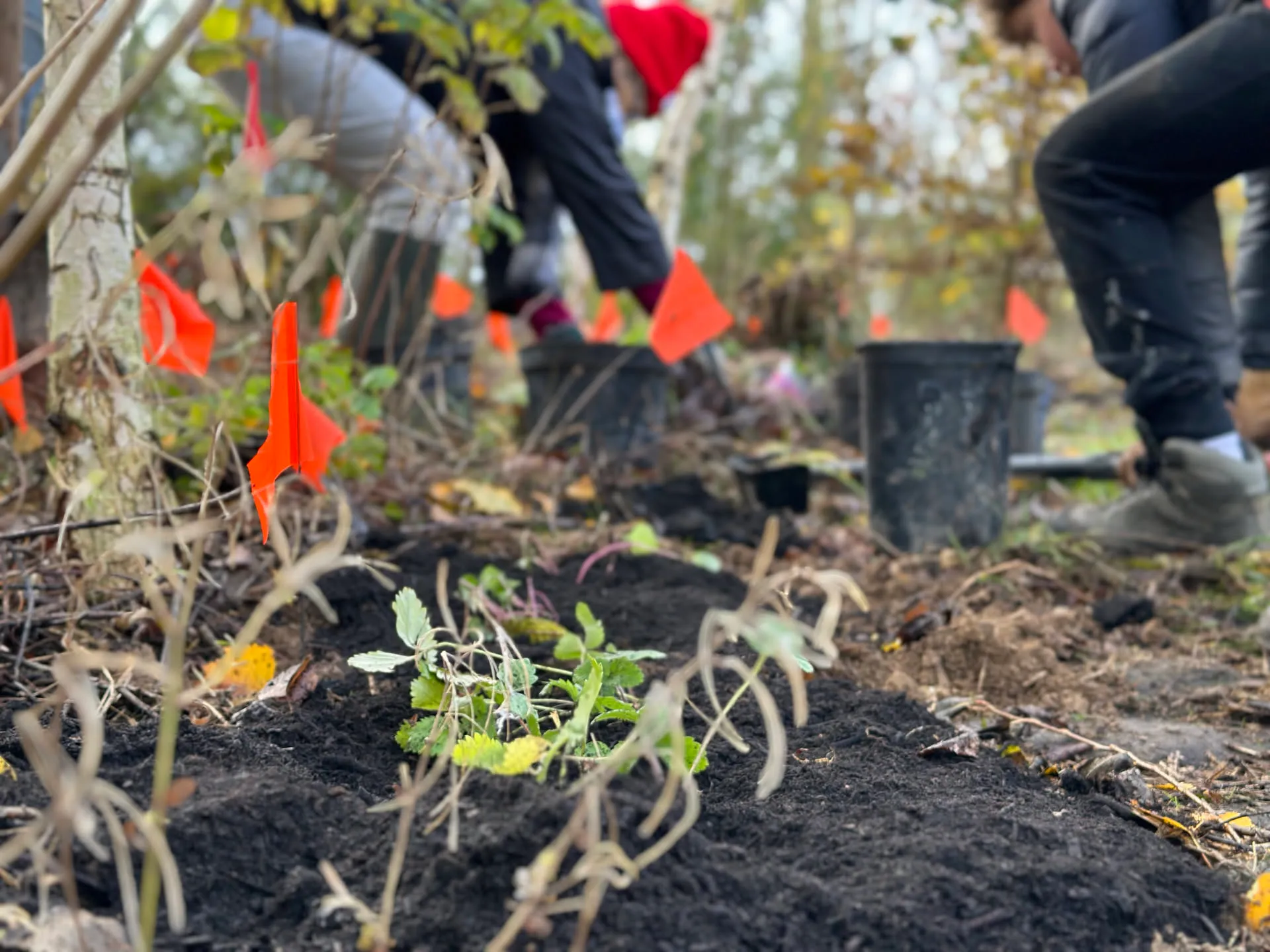
The hole is backfilled with the site's own soil. The compost forms a layer of at least 5 cm on the surface, kept away from the stem.
What compost does on the surface
Look at a forest. Nobody digs holes there to bury the leaves. Organic matter arrives from above, every autumn, and it is the living soil that carries it down: earthworms, woodlice, fungi. Compost on the surface repeats that gesture, faster.
First, it protects the bare soil you have just disturbed from pounding winter rain, frost and the spring drought. Then it feeds soil life where it is most active, in the top few centimetres. And the nutrients move down gradually towards the roots, across the whole width of the covered area, which invites them to spread out rather than circle inside a hole.
Bryant Scharenbroch and Gary Watson, at the Morton Arboretum near Chicago, measured it on maples and birches planted in a heavily compacted urban soil. Two and a half centimetres of compost laid on the surface every May raised soil moisture by 13%, organic matter by 57% and microbial activity by 39%. The trees grew markedly faster than the controls. A compacted city soil is not the former market garden at Naninne, but the mechanism is the same: you feed the soil, and the soil feeds the tree. We told what a food forest changes for soil life in the woodlice study.
One limit to know about: a bare layer of compost is also a perfect seedbed for wild herbs. The University of New Hampshire Extension flags it. The fix is simple, cover the compost with dead leaves or wood chips. That Sunday we had neither to hand, and the trees took care of it: the 2023 pioneers were dropping their leaves, straight onto the compost. That is the whole point of planting the lower layer under trees already in place, before leaf fall is over. And we come back to top up the cover through the winter.
The landscaper is not wrong everywhere, either. When the soil is building-site fill, sterile and compacted, Gilman’s trials leave the door open to amending. But the whole area to be planted, not the hole alone.
Your turn to plant
Planting season runs from leaf fall to March. For each tree or shrub:
- Dig a hole as deep as the root ball, no deeper, and two to three times as wide. Loosen the sides well.
- Backfill with the soil you took out, nothing else. The root collar stays level with the ground.
- Spread your compost on the surface, at least five centimetres, over a circle much wider than the root ball. Leave ten centimetres or so clear around the stem.
- Cover with dead leaves or wood chips, and water once, thoroughly.
And choose young plants: we explain why in Plant small, plant sturdy.
We pass these gestures on all year round with the Semisto Academy: days to discover food forests and learn grafting, a week to design your own project, and a full course to become a food forest designer. Come, we’ll show you: all our courses.
Sources
- Schulte, J. R. and Whitcomb, C. E. (1975). Effects of soil amendments and fertilizer levels on the establishment of silver maple. Journal of Arboriculture, 1, 192-195. auf.isa-arbor.com
- Smalley, T. J. and Wood, C. B. (1995). Effect of backfill amendment on growth of red maple. Journal of Arboriculture, 21(5), 247-250. auf.isa-arbor.com
- Gilman, E. F. (2004). Effects of amendments, soil additives, and irrigation on tree survival and growth. Journal of Arboriculture, 30(5), 301-309. auf.isa-arbor.com
- Hodge, S. (1990, revised 2012). Organic soil amendments for tree establishment. Arboricultural Research Note 86, Forestry Commission. trees.org.uk
- Scharenbroch, B. C. and Watson, G. W. (2014). Wood chips and compost improve soil quality and increase growth of Acer rubrum and Betula nigra in compacted urban soil. Arboriculture & Urban Forestry, 40(6), 319-331. auf.isa-arbor.com
- Iles, J. K. Tree Planting Basics. Iowa State University. hortnews.extension.iastate.edu
- Royal Horticultural Society. Trees and shrubs: planting. rhs.org.uk
- Neal, C. (2017). Planting and Mulching Trees and Shrubs. University of New Hampshire Extension. extension.unh.edu
- Schuch, U., Kelly, J. and Tipton, J. (2012). Planting Guidelines: Container Trees and Shrubs (AZ1022). University of Arizona. extension.arizona.edu