Plant small, plant sturdy
The young whip often catches up with the three-metre tree planted next to it, and holds up better. The studies, Naninne in photos, and how to plant this autumn.
Michael Hulet and Nova Published September 9, 2026


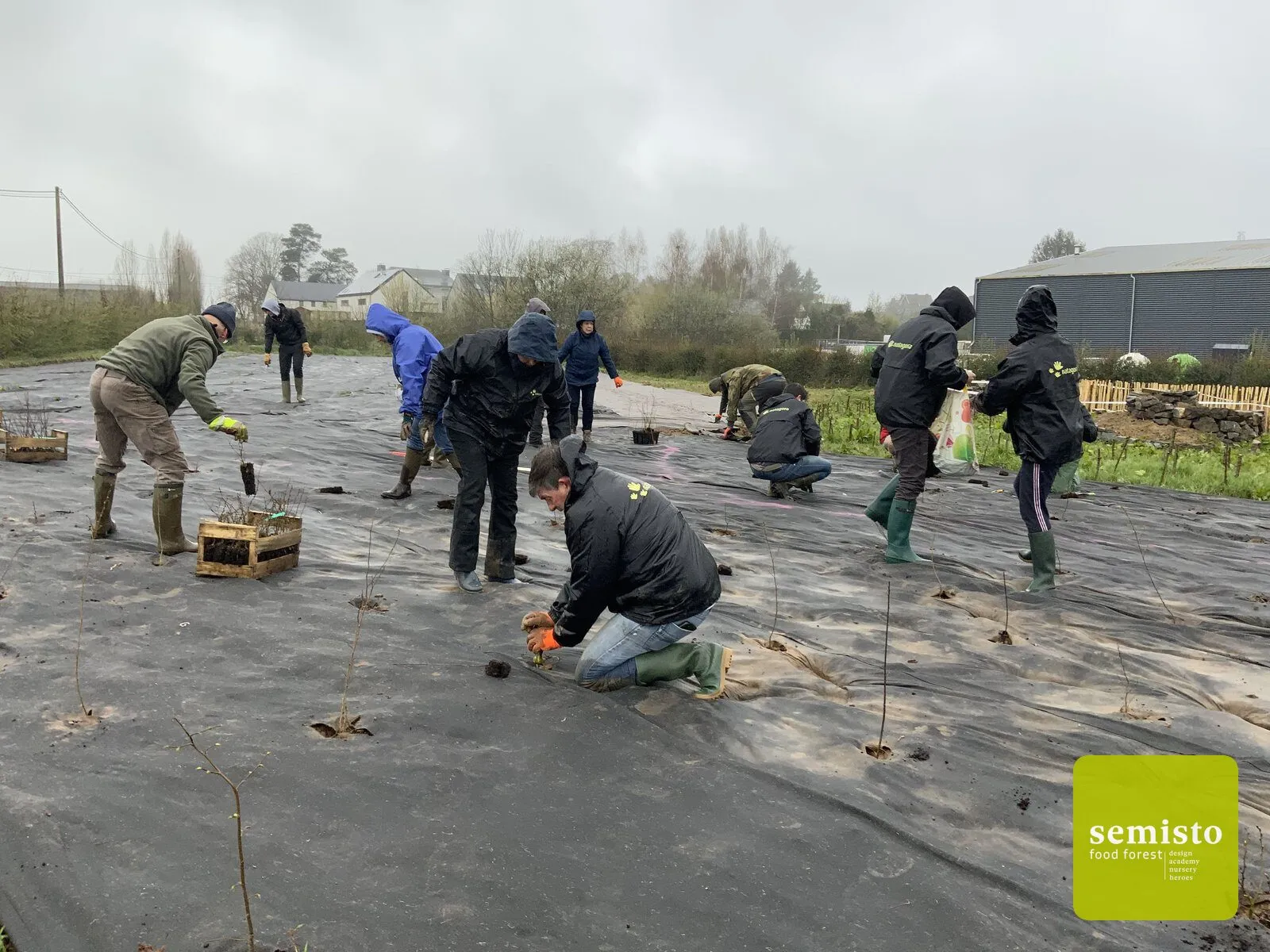
April 2023, Naninne. Grey sky, a few drops at most. About fifteen people in rain jackets move forward on their knees across a black tarp, a wooden crate beside each of them. In the crates, forestry plugs, knee-high: alders, birches, black locusts. Twigs. We put 1,400 of them in the ground that day, one per slit cut in the tarp, on twenty ares of former market garden.
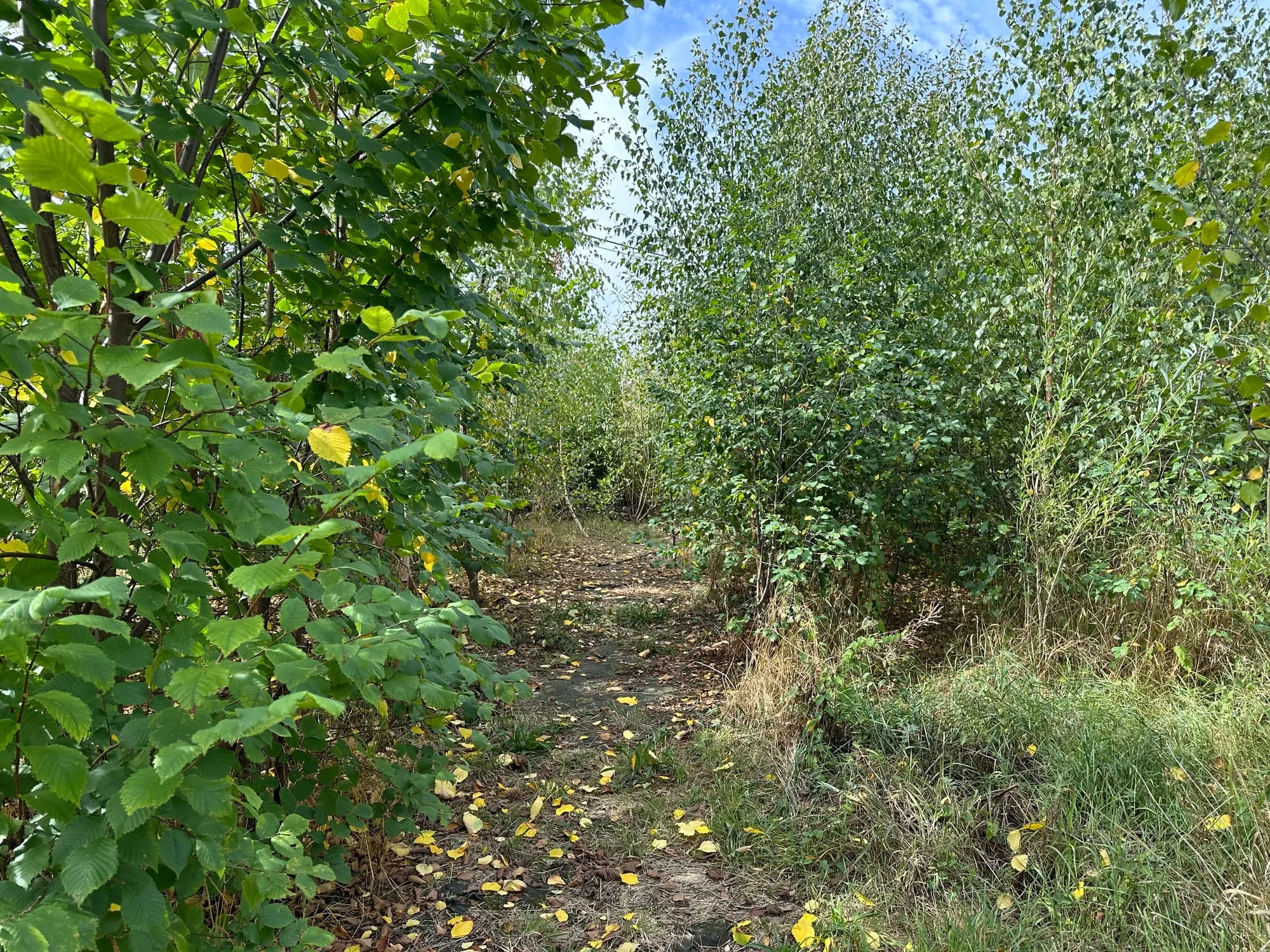
August 2026, same spot. The twigs stand three to four metres tall, their crowns touch, and you walk in the shade along the alleys, on a carpet of leaves. Three summers were enough.
Nothing exceptional there. Planting small almost always gives this result, the opposite of what instinct whispers.
The big-specimen reflex
In front of the garden centre display, the choice looks simple. On one side, a tree already formed, two or three metres tall, in a container, with a two-digit price tag, sometimes three. On the other, a bare-root whip knee-high, sold for a few euros. You tell yourself that with the big one you gain five years. You pay for the head start.
Except the head start melts away. In most situations, the small one comes out ahead.
What happens below the ground line
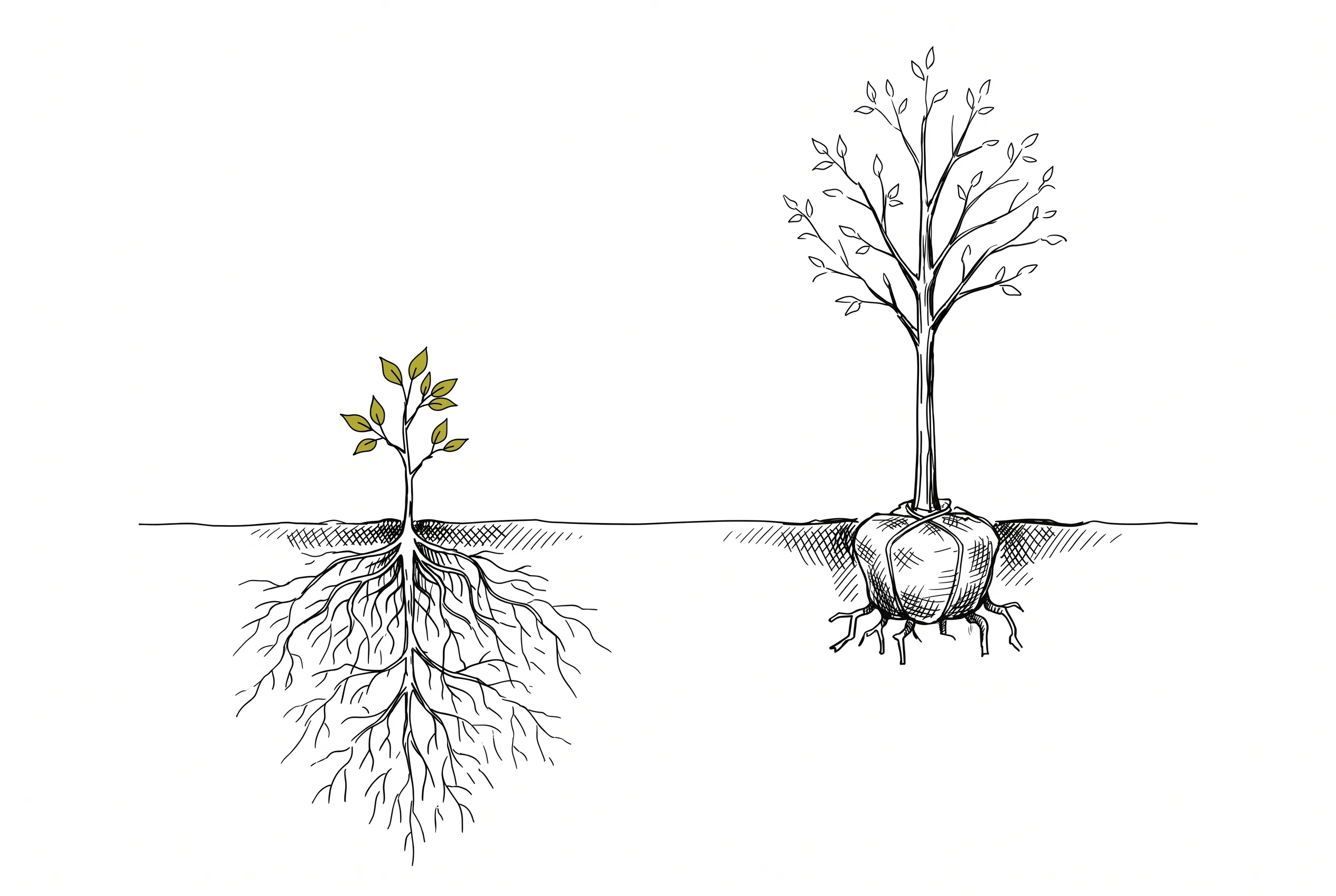
A tree that gets moved loses its roots. Gary Watson, a researcher at the Morton Arboretum near Chicago, put numbers on the problem back in 1985: when a nursery lifts a formed tree to ball it, up to 98% of its root system stays in the field. What leaves with the tree is a stump.
The tree then spends years rebuilding what it lost, at a rate of about forty centimetres of new roots a year, outwards. For a trunk ten centimetres in diameter, Watson counts five years before the root system regains its spread. For a trunk of twenty-five centimetres, more than thirteen years. All that time, the tree grows little, suffers at the slightest drought and lives on its reserves.
The young whip has almost nothing to rebuild. Lifted at one or two years old, it takes most of its roots with it. It spreads them straight into the soil where it will live, at the pace of its leaves, and its growth never stops. By the end of those thirteen years, Watson calculates, the tree that started at ten centimetres has a good chance of having overtaken the one that started at twenty-five.
A team at Ohio State University ran the full-scale test on red oaks, published in 2000: twelve large specimens 8.4 centimetres in diameter, twenty-four small ones at 3.6 centimetres, same genes, same vigour at the start. In the second year, seven of the twelve large trees were dead. None of the twenty-four small ones. The surviving large trees then grew a little faster than the small ones, and the authors point it out. But you don’t plant for the average of the survivors.
Taking is the only number that counts
In Wallonia, the SPW only releases its planting grant if 80% of the plants take. On our sites, it is also the only measure we care about in the first year: how many break bud in spring.
On that score, the young whip has everything going for it. It needs less water, because it has few leaves to feed and roots to match. It does without a stake; the wind builds its trunk. It hasn’t spent three years in a pot winding its roots into a spiral. And it costs a few euros where the formed tree costs dozens, which means you can plant ten times as many and let the ground do the sorting. That is the bet behind Naninne’s 1,400 pioneers: many, close together, small, and the ones that take close the sky in three years. There, we used forestry plugs because we were planting in April, outside the bare-root season; the principle stays the same, young and small. We have written about why we always start with these support species.
What we saw in Ittre
At the Jardin d’Eve in Ittre, Damien, Sophie and Ophélie Goemaere planted their forest garden in 2017 on a former horse paddock of thirty-five ares. When Ophélie Goemaere showed us round in June, she was clear on this point: they planted very young, because smaller is sturdier, and a big transplant means stress. All at once, too, to make the most of the machine hired for digging. Nine years on, the garden yields fruit, berries and herbal teas, and the family replaces its trees with its own cuttings and its own grafts.
Where the big specimen keeps its place
A screen you need right away. A street tree exposed to bikes and mowers. A standard-tree orchard, which the Walloon grant in fact requires with a trunk of at least 1.80 m. In those cases, you go bigger, you stake, you water, and you accept the years of establishment. Everywhere else, in a hedge, a food forest, a copse, an edge, the young whip wins.
It has one requirement, just one: its first two summers. A thick mulch, protection against rodents and roe deer, and water if the sky doesn’t provide. The summer of 2026 reminded everyone of that. A plant that gets through its first two summers is a plant you never touch again.
This autumn, at your place
The bare-root season opens at leaf fall and runs until March. From your nursery, ask for one- or two-year-old plants, the 60-90 centimetre grade for a hedge, feathered young trees for those meant to grow tall. Choose species for the climate they will be adult in, not today’s. Plant when the soil is neither frozen nor waterlogged, the root collar level with the ground, and mulch straight away. If your planting fits the SPW’s criteria, the grant covers a good share of the plants.
To learn the gesture before doing it at home: on Sunday 15 November, we plant the next layer of the Naninne food forest, under the canopy of the 2023 twigs. The morning starts with ten minutes of training, tools are provided, lunch is on us. Come, we’ll show you.
Sources
- Watson, G. (1985). Tree size affects root regeneration and top growth after transplanting. Journal of Arboriculture, 11(2), 37-40. auf.isa-arbor.com
- Struve, D. K., Burchfield, L. and Maupin, C. (2000). Survival and growth of transplanted large- and small-caliper red oaks. Journal of Arboriculture, 26(3), 162-169. auf.isa-arbor.com
- Service public de Wallonie (May 2024). Vademecum: planting a hedgerow, a linear coppice, an orchard and a tree row. yesweplant.wallonie.be
- Jardin d’Eve, Ittre: jardindeve.be and RTBF, 29 November 2022, Ittre : le jardin d’Eve, une forêt-jardin regorgeant de fruits et de fleurs. Semisto visit of 5 June 2026.